Where Did I Leave My Keys?…

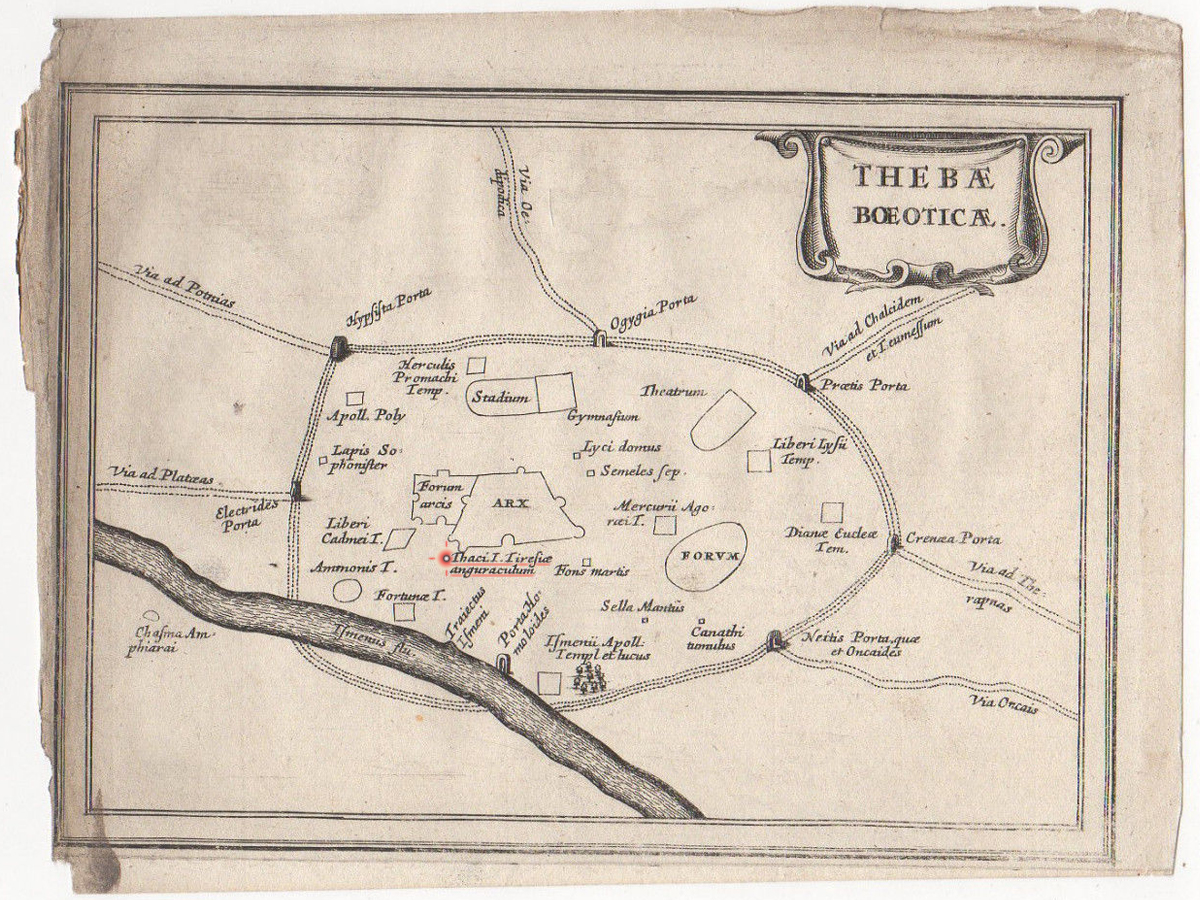
As I mentioned on Dec 1, mythology claims Teiresias worked in a bird observatory (oionoskopeion). Whether it was in Thebes or outside the city is a matter of some debate. And I’ve decided to go with Laurenberg’s placement – next to the Citadel.

A Song Heard in the Future*, the working title of my novel, uses TeiresiasTower for many critical scenes. I am painting it as the home and headquarters of the Spartoi, the Seer’s grandfather and great uncles. It served as his tomb until (presumably) destroyed by Alexander the Great (335 BC).

My storytelling has been mainly as a raconteur and presenter before Leanna Renee Hieber encouraged me so effectively. In the past, more than a few of the tales I told were the plotlines of roleplaying games. I never quite left the hobby. A few years ago I became fascinated with paper model terrain and started making some models of my own.

I can handle two birds with one stone – in mapping out Teiresias‘ home and making the paper model kit. When finished, the model will stand about 8 inches tall. If it turns out well, I’ll be selling the kit to gamers.

While writing this post and determining what title it should have, I remembered an old “joke” of mine regarding prayer and how frequently it seems to go unanswered. Imagine that muttering aloud about a wallet temporarily missing during the morning routine counts as a prayer. There could be millions of such distractions in a single day – worldwide. That could eat up a lot of time for addressing more important petitions to the Divine.

It likely won’t be in Song but I can imagine Teiresias might be asked, “Where will I find [missing item]?”

Teireseia's Tower scaleup

* The title is a quote from Lord Alfred Tennyson’s poem, Tiresias.
Right from the Start…

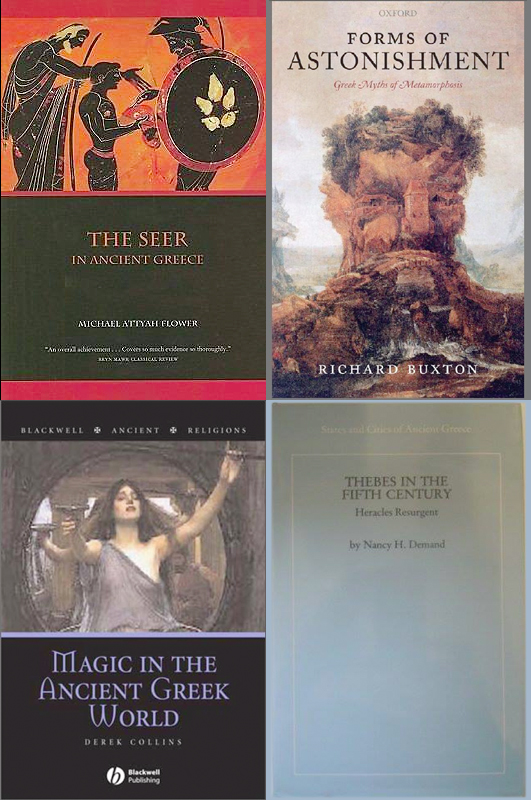
After Bulfinch’s Mythology and Mythology by Edith Hamilton, there have been four stand out books while researching my novel about Teiresias.

next blog

  • The Seer in Ancient Greece by Michael Attyah Flower
  • Forms of Astonishment: Greek Myths of Metamorphosis by Richard Buxton
  • Magic in the Ancient Greek World by Derek Collins
  • Thebes in the Fifth Century: Heracles Resurgent by Nancy H. Demand

Perhaps more importantly, I have so far interviewed about a dozen good folk who have different experiences than my own regarding philosophy, religion, life and living.

For purposes of the story, I have been assuming Teiresias would have lived about 2750 to 3000 years ago. I decided that he was born two generations after Deucalion’s Deluge. Though it’s largely the same story, the date doesn’t quite match what James Ussher calculated as the time of Noah’s Flood – 4359 years ago.

Mythological stories still resonate with us for at least two reasons:

  1. They are reinterpreted by each generation according to the Zeitgeist and
  2. Regardless of how long it may have been since the Flood, the deity, and the survivors – the myths tell us that – in some important ways – no one’s life experience now is very different from that of the people who heard those tales first.

It probably won’t be long before there’s a trend analysis app that helps us anticipate aspects of the future. I predict it won’t be called Teiresias.

Really‽… (Oh! Good!)

On Day One of this journal and account, it would be quite unfair to hint that Teiresias is the only muse for my present research, writing, and art. I have never known true encouragement for this sort of work. Not like this.

Leanna Renee Hieber is an established, successful author with seven books to her credit, including the upcoming The Eterna Files (releasing from Tor Books on 2/3/15).

Along with Bruce Boxleitner and Trevor Crafts, we first appeared together on a New York Comic Con panel together – Diana Pho’s Welcome to the Brass Screen (10/10/2013). Later that evening and during dinner, the seeds were sown for Leanna and I sharing an affinity in terms of creativity. We knew we wanted to work together but were uncertain as to how we might do so. I was not surprised to learn that she is also a talented actress and singer. Other projects of mine were going to require both. I began looking for opportunities to which I could invite her.

During this nearly-past year, she started expressing appreciation for my talents and perspectives. We began developing a character for an upcoming television series and as her (the character’s) back-story grew, we felt she had greater potential in a fuller story. This character prompted Leanna to select me as a co-author.

At first, the offer was a shock and surprise. I want to emphasize how astonishingly rare this kind of support has been in my experience. I had imagined becoming an author as early as 1976. (I was 12 years old.) My mother was antithetical to encouragement; she found what I wanted to write about frightening and potentially humiliating. Do I have to say how terrible it is to have a dream shot down by a parent?

My Very Dear Friend Leanna Renee is the precise and critical opposite. And I’m EverThankful we met. I recommend purchasing her novels. I’m working my way through them as I write my own, solo books (including the Teiresias tale) and she and I plan our future novels together (the first of which involves that very special character mentioned above).

Mapping It Out…

And so – as I approach this story – it matters to me to try to understand the characters and how they live. There is some evidence in scholarly text that Teiresias had an observatory.

“Fantastic!” I thought. “I love astronomy.”

But it’s not that kind of observatory. More reading showed that it was an oinoskopeion or a site for ornithomancy: divination by means the flight and songs of birds.

Some of the sources hinted that a map existed showing the tower. I’ll admit to becoming a bit distracted by this. I had to find the map. Sometimes items for sale on ebay can be valuable for research – whether they are purchased on not. One seller had offered a page from the atlas produced in 1660 by Joannis Laurenberg. A rough map of Ancient Thebes was featured and one of the dozen or so buildings included, all ringed by seven temples and seven gates, was the Tiresiæ Auguraculum. (With apologies to the seller, the Buy It Now price was/is $120. There was no chance I’d buy a copy.)

In the image below, the site of the Bird Observatory of Teiresias is shown near the center and toward the lower left. It would have been to the east of the Citadel of Thebes and the main market forum. The tower, if it existed, would likely have been taller than most of the Citadel. By comparing it with another (hypothetical) map* of Ancient Thebes, it might have stood on the northern lobe of the Ismenian Hill.

Map of Thebes

* a topographical map from William Smith‘s “A Dictionary of Greek and Roman Geography”

Jumping In…

As this is the first official post, I thought I’d explain the title “Surfing the Zeitgeist”. It’s a bit of a mixed metaphor with a hint of staying ahead of the curve. If the zeitgeist were an actual spirit in the paranormal sense, rather than being possessed and controlled by it, what would the converse be? How would it be properly bound and what could it be made to do?


In a very strange way, I have fallen into researching and writing a novel. And it isn’t the novel I thought I’d write first; something more directly arcane was the intended launch/debut.

Before what I believe to be a compelling story emerged, I had been musing on a fictional timeline for some themes that have always been of interest. The plan was to track the concepts of justice (diké), hope (elpis), and equality (isotés) back to the Dawn of the Heroic Age, i.e., the aftermath of the Flood. In Ancient Greek belief, the story of Noah was equivalent to the Deluge of Deucalion.

I think I expected the center of the myths to fall in Athens or Corinth but Thebes became the focus, a city-state described as the “anti-Athens”. It was a quote from the fragments Sophocles that metaphorically caught my eye: “At Thebes alone do mortal women bear immortal gods.” It is a reference to the sons of Semele and Antiope – Dionysus and Heracles, respectively.

Some assumptions had to be made:

• In the Greek version, how many years ago did the Deluge happen?

• How long is a generation?

• Was the father of Dionysus Asopus or Zeus?

• How long after the Flood did the Argonauts sail and did Heracles really travel with them?

And so on…

The timeline rather quickly became both an outline of concept tracking and a tool of projection into the future. What will justice, hope, and equality mean in the distant future? With that thought, the novel began to haunt me – and then compel.

One character stood out in the timeline I was crafting. He has almost always been, in essence, the leader of the Chorus and never the lead. Teiresias, the famous blind seer, quickly became the fulcrum of the timeline – past to future – and the central character.

But his (or her) mythology is about as consistent as any other story Ancient Greek oral tradition presented. It isn’t possible to craft a unified lineage and timeline from Prometheus bringing fire to mortals through to the Fall of Troy. And with Teiresias there are conflicting accounts about whether he was born male or female, how he or she became blind, and how many children the prophet may have had (and by/with whom).

I had to give my own account regardless of whether Plato and Homer would agree.


And what have I learned at this point in this exploration?

• What will writing a novel do to me? –  As mindful of Diké, Elpis, and Isotés as I may be, I can always do better.

• Don’t get distracted. – If most of the action is set in Thebes, don’t worry about what’s happening in Endor.

• Write my own story. – If the novel’s premise involves denying some of the “established lore” – stick to what the story requires.