Seriously?…

seriously

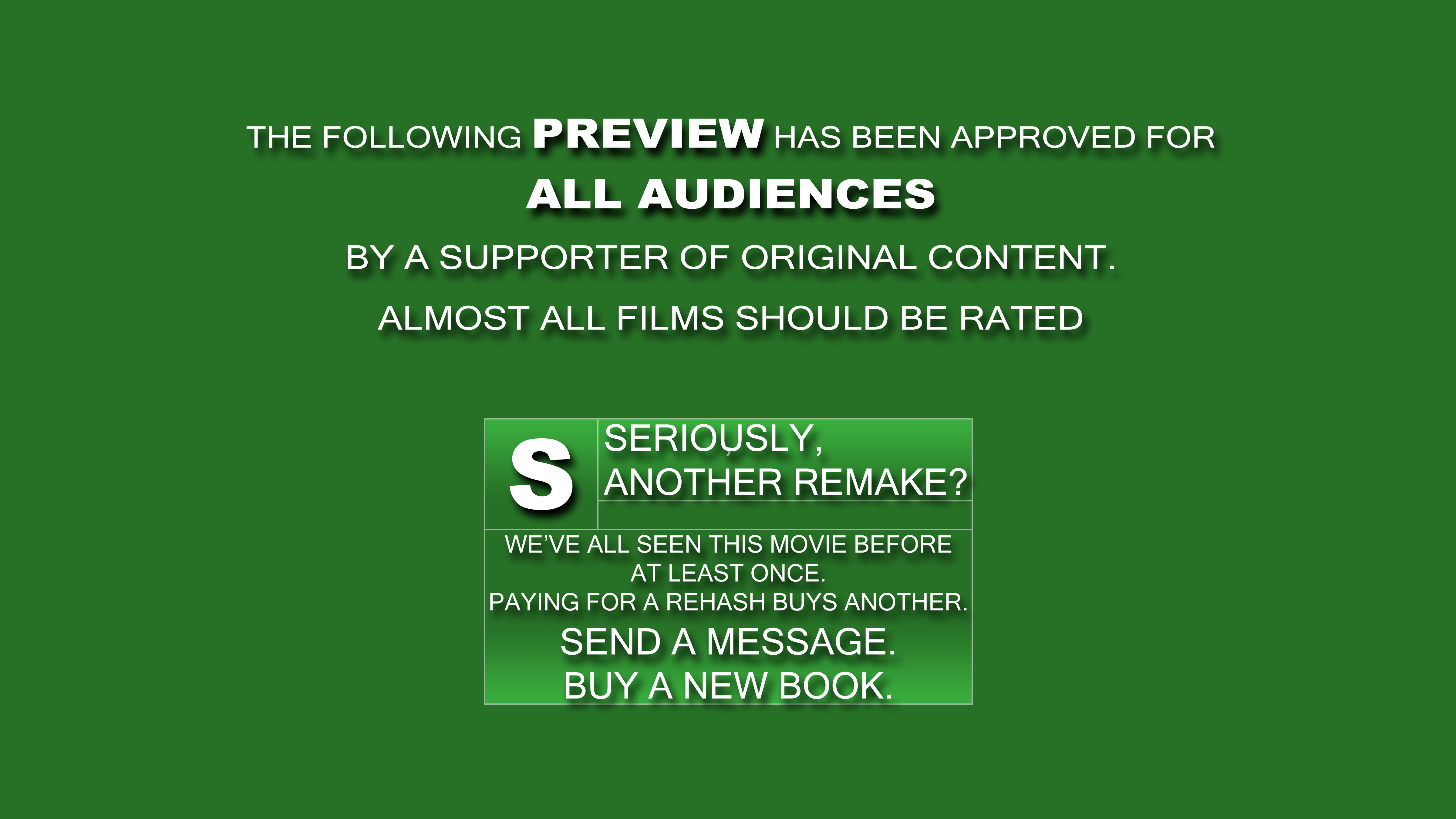
Whether called reboot, reimagining, or remake – there is, at least, one almost guaranteed reaction when Hollywood makes the announcement: There is nearly always complaint by loyal fans of the quintessential (older) version.
And when the film is released, it never plays to a completely empty theater.
Nearly 125 remakes were released between 2003 to 2012. That would be one a month, on average. Said remakes brought in a combined box office gross of $12 billion.
The explanation for the remake frenzy is “the foreign market”. I’m not sure I buy that. Surely folks in The People’s Republic of China (中华人民共和国) get just as bored by/tired of an endless chain or rehash as anyone else.
I think… I hope — that the people of the Republic of Nauru (Naoero) are desirous of new and original ideas and content.
Hollywood’s emphasis on the reliably bankable is a polite way of saying they are risk-averse. Similarly, when they want it accessible, that means they don’t want to challenge or offend.
But personally, I enjoy having my assumptions challenged and my knowledge expanded. A film can be both confusing (at first) and offensive (if for effect) – so long as the end result is teaching a valuable, needed lesson. And, yes, I do expect a message from entertainment. If there isn’t to be a message – fireworks displays are free and generally ubiquitous during blockbuster season.
Nearly all work by the motion picture industry is based on brand & franchise now. There were times – and not so very long ago – when filmmakers were just as interested in story and moral as I still am.
The above Hollywood preferences may have contributed to the opinion – voiced by many – that Hollywood is out of ideas. That’s absurd. There are new novels being published every month.
The solution is clear! Reward storytellers.
Don’t go a see a film unless the trailer, pre-release press, and/or critical reviews illustrate that said film presents a new idea.
Buy a book instead.
You probably know an author. You may be one. We craft stories that we feel make important observations about life and may offer the equivalent of life-hacks within our work. Sometimes telling these stories means a sacrifice or two in the life of the author. There are tales behind the tales a reader may never know. When you hold a new book, and before you start reading, try to imagine the heroic journey the author (along with her or his allies) have already been on to see it safely into your hands.
The novel is a kind of gift-with-purchase. What you pay for is that unknown adventure the author has been through to tell you something potentially important.
If enough people do this – buying a book Instead of seeing a movie – some studio is bound to option a story you’ve read. We won’t have wasted money on a disappointing two hour retread. We also actually own a book as an added bonus.
Everybody wins! You, the book store, the publisher, the editor, and the author all get to smile. The film executives will wonder why – until the buy and read it too.
Coming soon…


But Thinking Makes It So…

As part of his forward for the 16ᵗʰ topic treated by The Visual Encyclopedia of Science Fiction (Harmony/Crown Books, US; Pan Books, UK – 1977) Larry Niven stated that telepathy, psionics, and the like could result in poor writing and suggested that it is the limitations an author sets on such fantastic powers that makes them interesting. His caution was one of avoiding wish fulfillment.

There are similar arguments made about souls and any sort of after life. Devising a series of tests for the existence souls and what fates may await them could be more difficult than scientific analysis of psychic prowess. Nikola Tesla performed an experiment to do just that. Would Mr. Niven make a similar argument about wish fulfillment here too?

The wish made manifest is one of the components of achievement. Isn’t what we do and make how we craft our sense of meaning and value? What tests may show often matter less than the results of having some belief in something eternal, particularly in conjunction with those crucial senses.

I look upon death to be as necessary to the constitution as sleep. We shall rise refreshed in the morning. Finding myself to exist in the world, I believe I shall, in some shape or other always exist.”
Benjamin Franklin

In an interview in the San Francisco Examiner (26 August 1928), Henry Ford said the following:
I adopted the theory of Reincarnation when I was twenty six. Religion offered nothing to the point. Even work could not give me complete satisfaction. Work is futile if we cannot utilize the experience we collect in one life in the next. When I discovered Reincarnation it was as if I had found a universal plan I realized that there was a chance to work out my ideas. Time was no longer limited. I was no longer a slave to the hands of the clock. Genius is experience. Some seem to think that it is a gift or talent, but it is the fruit of long experience in many lives. Some are older souls than others, and so they know more. The discovery of Reincarnation put my mind at ease. If you preserve a record of this conversation, write it so that it puts men’s minds at ease. I would like to communicate to others the calmness that the long view of life gives to us.”

KarmikPrinciple2Franklin and Ford were both (arguably) great. Both the lightning rod and automobile are still in use. These views very likely helped both inventors in being able to accomplish their work. It seems to have reassured them and helped them recharge.

It might matter less who we have been in past lives than who we may be in future iterations. Imagine a reliable method of access to what we’ve learned so we can always hit the ground running. I could put it on my perpetual calendar that I had an appointment with Dr. was-Franklin and Mr. was-Ford on 17 June 2373 in a little pub called The Silver Lining, deep in the Oort cloud . Imagine We Can Remember It for You Wholesale to the Nᵗʰ degree.

“I’ll get back to this.” Scheduled.

There is no Reincarnation Axiom. Tesla’s experiment did not substantiate transubstantiation. It doesn’t mean it hasn’t happened; there was no proof either way.

Be diligent in what you wish for. Anything can happen.

infinity sergeant copy

The Fault — Is Not in Our Stars…

A component of being a purist may be thinking that the science in science fiction should be reasonably valid and the result of some research. If so, then I am at least partially a purist. If a starship can go anywhere in the galaxy in a few seconds, the accomplishment of space travel becomes quite meaningless. How do we preserve a sense of awe? How can new science fiction inspire the next generation of scientists and engineers?

In a less lofty capacity, if a writer won’t do a bit of research to make the science feel correct is it fair to assume they might stint on other details? Yes, it’s true that the emotions and growth of the characters is the vital core of fiction. How the main character feels may be the best way to capture a reader’s desire to identify with her or him. Comparing that character at the start of the tale and its conclusion provides the essential meaning of the journey.

We’re hard on our potential fictional heroes for a reason. They are more than reflections of our selves. They can – and when done best, should – mirror who we hope to be. The worlds in which they live illustrate where we hope to live. In rare cases, sci fi heroes can help us get there.

Science fiction can serve to criticize the aspects of our society that warrant correction. When the emphasis is on good science, the genre includes a different rationale than some others: that the meaning of our journeys can be understood. There are truly cosmic answers that can be had.

If the rocketship can reach the Moon in less than ten seconds, the landing pad can be green cheese. In “All We Now Hold True” it matters How Far and How Fast. Part of the story is a race against time.

rom-halan-draftDescriptions in prose and by equation need not be in conflict. It has recently been pointed out to me that some of my explanations of formulæ can wax poetic. Balance is part of my preferred aesthetic, whether in composition or equation. Science and math – like hue and light – underlie representations of beauty.

sic itur ad astrathus one goes to the stars

Into the Blue Again…

all we now hold trueThe phrase “there is nothing new under the sun” has always bothered me. Until beginning this post, I did not know it was Biblical. It reads in full: “What has been is what will be, and what has been done is what will be done; there is nothing new under the sun.”

It always seemed so discouraging. While I was a teenager, it almost offended me.

Similarly, when I was growing up, I had a profound dislike for some of the lyrics of All you need is Love.

There’s nothing you can do that can’t be done…”

I cannot say when I learned the value of inverse statements. Second guessing Ecclesiastes is not the aim here but the Beatles may have been making the point that if one person can do something – even if that person is the only one capable of the task – it is not impossible.

Given a choice between the two, why wouldn’t we choose the more bolstering message? There’s too much in the zeitgeist that suggests there are no solutions so any effort is without efficacy. Lethargy’s a Hell of a way to live; acedia was once included among the Deadly Sins.

Last week’s post was part tribute to the memory of Leonard Nimoy and part notice of encouragement to try something about which I’ve been musing for perhaps my entire life. (I cannot be sure. I don’t remember the very early parts.)

All We Now Hold True is meant to shine the light of Vulcan through a new prism – at a new angle – and get different colors and perspective. Perhaps I’m missing the point of the verse but my work is new under the sun because only I can do it. I am new under the sun – due to inspiration and in hope of returning the favor.

It’s easy.”
John Lennon