Tell me. Let me not guess.

It took a while…

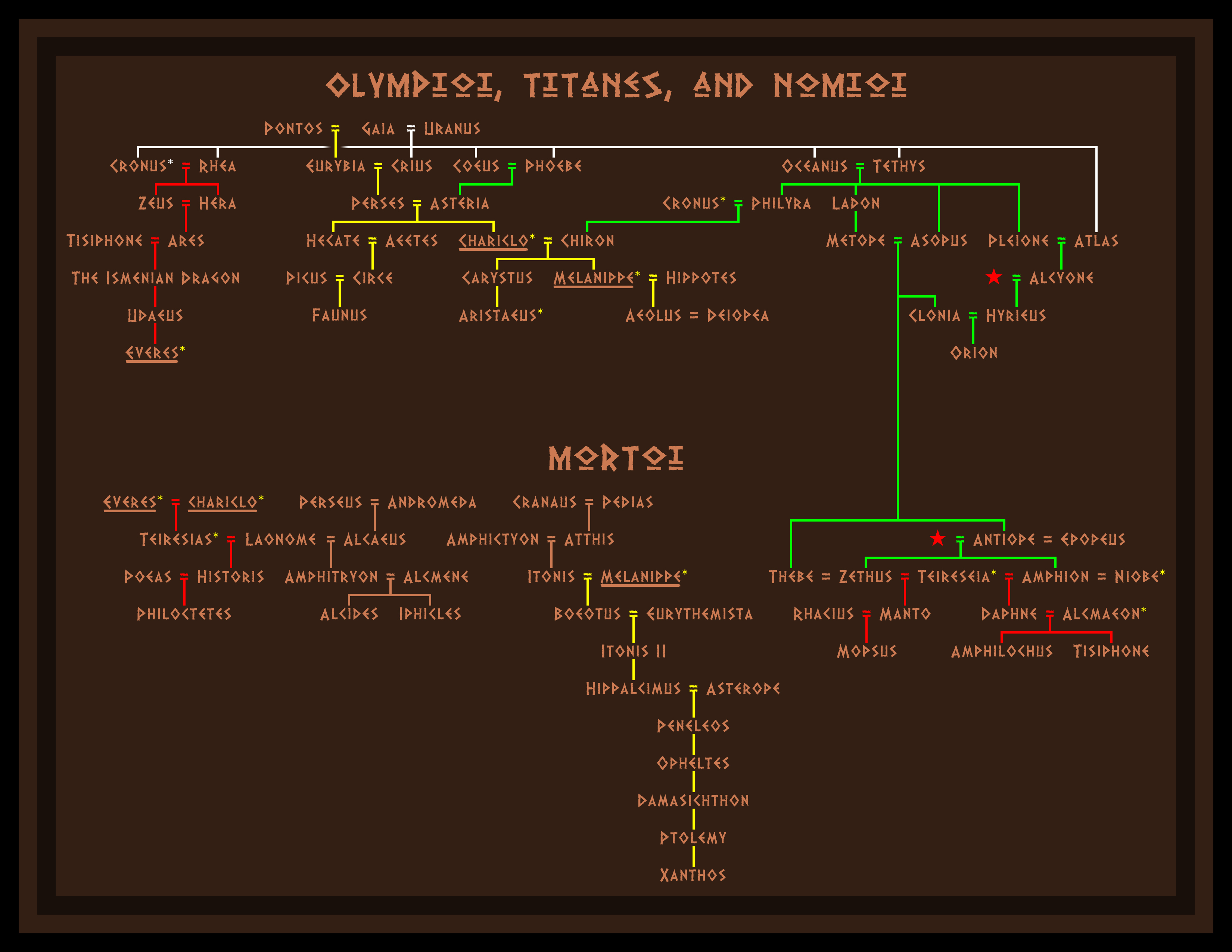
For artThis chart shows the lineage of most of the characters involved with the major plotlines of A Song Heard in the Future – as a single, rather extended family. Scholars of the Greek myth might be able to detect a few contradictions between this and attempts by other. For example, according to some, Hecate was a virgin goddess. Aeëtes could not have been her husband – and father with her of Circe.

Parentage is just one source of discrepancy. There may be two characters named Chariclo – one marrying Chiron (with Carystus and Melanippe as children) and the other Everes (giving the world Teiresias). I’ve decided that Chariclo is just one person – nymphe – having had two marriages. More than a few myths will show a character as the son or daughter of another, while a related telling indicates the name of the son or daughter is actually the spouse. Is Antiope the daughter of Asopus and Metope or of Nycteus and Polyxo?

Then there’s the omission of a spouse, usually the wife. While there are myths that state Teiresias had at least three daughters. There are no accounts of the other parent(s). I’ve made my own selections here.

The last of the puzzles posed by mythology is there is no evidence in any myth that Historis (the presumed eldest daughter of Teiresias) married and had children. Her wedding to Poeas, the Argonaut archer, is another choice of art.
Talos

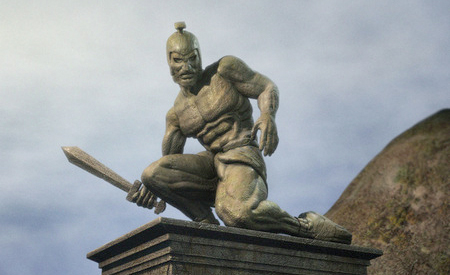
Talos, from Jason and the Argonauts (1963, Columbia Pictures)*

* Ownership of the image of Talos is neither claimed nor implied. In mythology, the automaton was created Hephaestus. In the film, by Ray Harryhausen.

Two red stars indicate the divine partners of Alcyone and Antiope. A simple search will find the names I’ve not shown. From the perspective of these two women, it may not be completely wise to disclose the presumed Pops.

A few characters’ names appear more than once on the chart: Chronus, Everes, Chariclo, Melanippe, and Teiresias/Teireseia. The first four are immortals and, therefore, capable of being sexually active in many different generations – sometimes century or longer apart. With the last, the seer undergoes a famous transformation and becomes part of two different families.

It may not be possible to build a family tree of Greek mythological characters without what some would consider errors. The stories involved are part of an anthology written by Greeks and Romans over almost a millennium. The authors didn’t always compare notes. A very respectable effort was made in A Genealogical Chart of Greek Mythology (2003, University of North Carolina Press). Two factors prevented me from using it for Song: 1) It contradicts some of the connections I required and/or omits some of the characters I needed to use and, 2) the price is pretty high.

Writing is making decisions.

Was this trip really necessary? Given the need to keep track of more than 85 named characters (not to mention those not appearing on this chart), each of whom has at least some established history (according to Plato, Ovid, Pausanias, et al.); I think it vital.

Of course, I’ve no way of knowing if the book, when published, will include this chart or one like it. The reader may not benefit from it as much as I or the story itself have/will. Included or not, it will help me make things clear.


Note: The Olympioi and Titanes are, of course, the Olympian deities and the Titans, respectively. The Nomioi were the denizens of the non-human wilderness, including lesser divinities. It would have broadly included the centaurs (kentauroi), satyrs (satyroi), nymphs (nymphai), and river gods (potamoi). Mortoi means “mortals”.


☞⚡☜

Equal rites…

I know anecdotally that editors can be quite thankful when they do not have to remind an author that people have different ethnic backgrounds. Characters should also. Recently, as the research phase for A Song Heard in the Future came to a close, I found that is was not going to be difficult to include a range of heritage.

Given that almost any (every?) story set within the world of Greek mythology and worship will be a Mediterranean tale, the likelihood of an all-majority cast seems very, very low. That said, several of the major characters are not actually Greek.

diversity mapThe first king of Thebes was initially from Phoenicia and one of the kings of Thrace was a Libyan immigrant. Pygmalion (or Pumayyaton), the famous sculptor, was a Cypriot. The more-traveled characters may even have heard of a Titan by the name of Gadeiros from what would become Spain and Norax, a hero on the island we call Sardinia and the Greeks knew as Ichnūsa.

The biggest revelation to me regards the ancestry or a demigod famous for Twelve Labours. His great great grandparents were Ethiopian royalty. Is the world ready for a Hercules who is at least one-eighth black?

There is another story about publishing I’ve heard. I won’t repeat it here because it’s absurd and offensive but it regards the readership of science fiction and fantasy. We’ve moved beyond that, right? In this case, I’m hopeful that any future editor of Song will be intrigued by the prospect.

cogito ergo hmm…

Is it safe to assume most authors of fiction hold J. R. R. Tolkien in high esteem? I must admit that, to an extent, he’s something of a guiding star. I admire the thoroughness of his work and its success and apparent timelessness.

During the research process there are, of course, moments of discovery. Some data is deliberately sought. Then there are unanticipated details that, once turned up, seem essential to the story. I do not intend to take a decade to develop any of the worlds for which I’ve novels in progress; in that respect, Mr. Tolkien couldn’t be more remote were he a constellation. Aiming for comprehensive seems sufficient. Trying for exhaustive can interfere with the actual writing.

Within the past fortnight I’ve made some discoveries that may, in fact, prove vital in A Song Heard in the Future. The first concerns what seems to be everyone’s favorite constellation: Orion. In Greek mythology he was a giant, mentioned in both of Homer‘s most famous works.

While most of Song plays out over three or four generations, I felt it was important to thread as much of mythology through it as served the story. Some of the characters are able trace their ancestry back to survivors of The Flood (≈1440 BC, by my estimation, with Deucalion in the place of Noah); this becomes an important vantage point they have on themselves and their roles. Others sprang up from the earth in the aftermath of that cataclysm. For their descendants, having an autochthonous claim as a birthright, is equally momentous. According to the family trees I’ve developed in conjunction with the chronology, all of the featured characters would have known Orion only as a constellation. He’d have died before they were born.

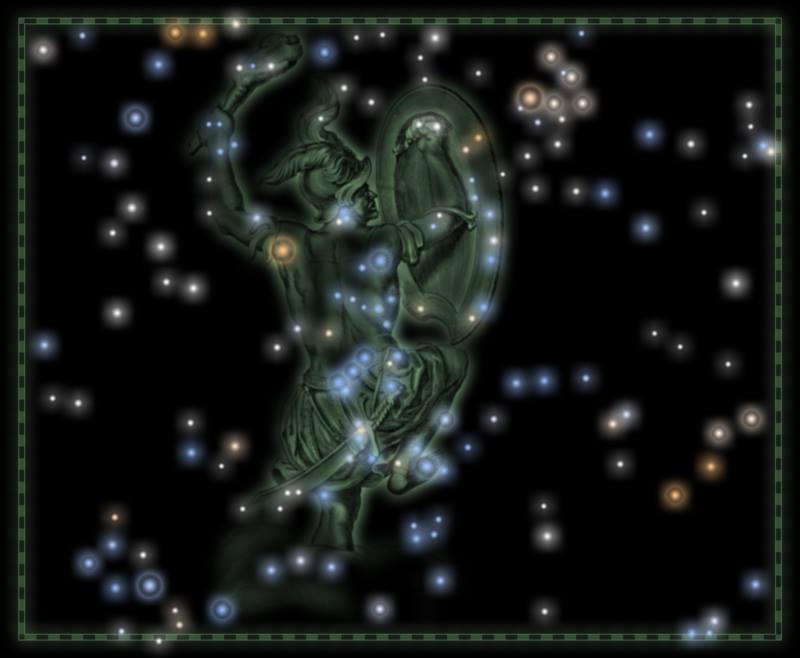
Orion-constellationOrion being mentioned this way seemed right. It helps me feel that the characters live in the world about which I’ve been writing. This unexpected realization also seemed to build similarity between those characters and the readers. They’d be looking at the same stars, calling many by the same names. For Teiresias, the constellation now holds a special significance.

It isn’t a surprise to me that I would find a way to include astronomy in some capacity. The subject has fascinated me – since before my love of Star Trek – and only enhanced by it. What was unforeseen was finding a pair of characters that served to buttress the narrative and share a name. In the timeline, I have them separated by about 180 years – one before The Flood and the other at about the time of the Trojan War (≈1260–1180 BC, according to Frank Calvert and Heinrich Schliemann). Genealogically, the younger character could claim the Antediluvian as tritavia†. This seemed designed as part of the story as if penned – almost literally – at the time Song ends (perhaps by Homer, Sappho, or Aesop).

The past two weeks provided a coming full circle sense with Song. I’m certain that more writing will create more unexpected moments of epiphany. These two gave me a smile. I welcome more.


great great great great grandmother


…tap to put a new Tome into play…

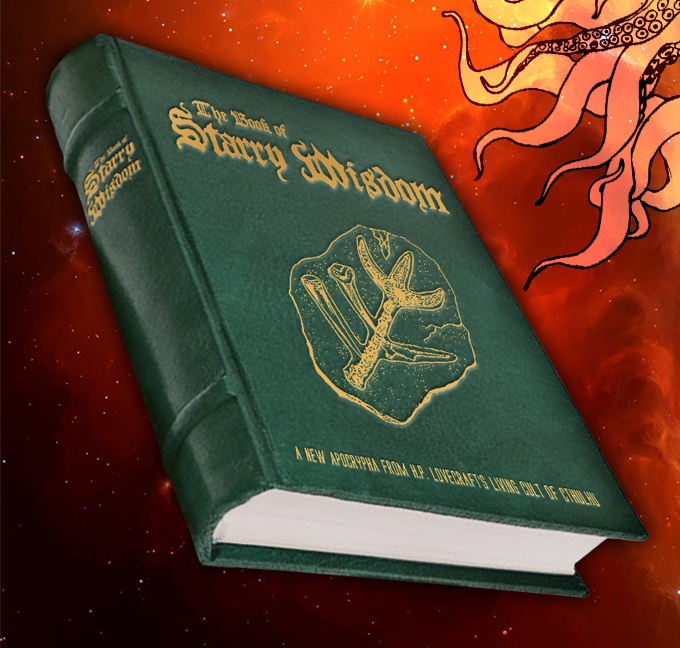
With just six days to go for the funding deadline (and it being solidly in the Halloween season) I would like to take this opportunity to remind visitors to this blog about Simon Berman’s kickstarter initiative to bring something new to the Cthulhu mythos. The book will be a collection of old and new stories set within and inspired by H. P. Lovecraft’s universe. And if this is the first post seen by a new visitor to Surfing the Zeitgeist, let me also add, “Welcome.”

Writing is about an adventure – an adaptation in character as the result of a crisis. I feel that’s what I’ve managed to contribute to the new book in question with my short story, “Letters from the Sea”.

If you have already participated in this kickstarter, you have my thanks. I would also request that you share the link and encourage others to join you in lending support. If you’re new to this blog and/or knowledge of this project, please view the kickstarter page and the archive, along with the art and illustration sections, of Surfing the Zeitgeist. Perhaps I can then extend the welcome to “Welcome aboard.”

For Copy & Paste ease, here is the link: http://tinyurl.com/p2yasta

achievement

ἐπιφάνεια…

Sometimes it is difficult to hear a particular Muse clearly. More often than not, it isn’t just one speaking to me. Ideas for sculpture, writing, and other art are coming all the time – simultaneously. From time to time, I will have to pause one project in favor of another. Even in an ideal world, in which I could devote every second of the day to the arts, I’m certain this would be the case. It’s just the way it goes.

During any pause on a specific writing project, there is not a complete silencing of the voices of the characters involved. They are, in the back of my mind, still seeking deeper subtext and greater clarity about their motives and missions. There’s probably no way to stop this and I wouldn’t want to. When research and writing resumes there are new epiphanies that, I feel, improve the richness of the work in question.

Recently, my thinking returned to the story of Teiresias, which I am calling A Song Heard in the Future (based on a quote from Tennyson’s poem treating the same character). Before the pause I knew there were two major holes in the novel. Two characters – both of whom are women – were going to disappear into them.

Being a seer, Teiresias is frequently a giver of advice. As a person, though, he lives through some truly fantastic upheavals. It stands to reason that he might – from time to time – seek some advice. Part of Song deals with this but for a while I wasn’t sure how.

The advice in this case becomes the foundation of the third act. The two characters who provide it were apparently very active during my break from this tale. They were in danger of vanishing from the story after merely being messengers. It is perhaps a platitude that an author’s characters speak to their creator. In this instance, these two were defending their importance. It really is like they knew.

One of them “reminded” me that she also had to be involved in some of the first scenes of the book. I can’t argue with the logic. And how could I have missed it‽

In trying to stay as close to the source material of Greek mythology (the origin of so many tales of heroism), it seemed a little cowardly to let important characters fade from the story and follow other paths to the end of the saga.

The song may be heard in the future but I have to listen to it, and the Muses, now.

muses light


🜀🝠

Horatio…

ghostAre there ghosts? According to one statistic, 45% of Americans believe there are. If they are correct, what are ghosts?

Throughout history, the common belief is that ghosts are the trapped souls of the deceased. Most often the trap represents something unfinished. What if that’s not exactly the case?

I’ve recently heard a theory that equates ghosts with a fading body of memory. A friend has made a distinction between ghosts and haunts, the latter being more echo than spirit.

Ghosts appear in either evil or good roles. What if they, like the living, can alternate between these two (or any two other) states. In nature, fluids flow around objects – sometimes to the left, sometimes to the right.

CapeVerde.A2005005.1225.250mFlowing fluid sometimes creates what’s known as a Kármán vortex street†. In addition to some oddly organized cloud patterns when winds are disrupted by a particularly tall structure or mountain, the same aspect of fluid dynamics can cause singing cables (vortex-induced vibration).

Vortex-street-animationWhat if something comparable is part of the cause of what we call ghosts? Or, to be more precise, around and “downstream” from each ghost. The key question might then be – “What is the fluid?” The most common answer, I could predict, would be æther. A century± ago the answer might have been ectoplasm. Ghosts are traditionally associated with a specific location but appearances do not occur on a reliable schedule. This could mean that the ætheric flow rate is not a constant.

This is, of course, not to say that there hasn’t been some attempt at science vis-á-vis ghost phenomena. Beginning in the Victorian era, and lasting well through both World Wars, many celebrated minds and names were engaged in the study — perhaps most famously the Doyle camp vs that of Houdini — but that is another story.

doylehoudiniSome who report sensing ghosts claim to see them. Others hear them. These variances could suggest either different fluids or they might depend on the relative “shape” of the ghost involved. There are a fair few TV shows about detecting ghosts with indistinct recordings (both audio and video) offered as evidence. These shows are ultimately unsatisfying from the perspective of what hauntings may truly be, how they’ve been caused, and what to do about them. Perhaps ghost hunters and –busters is the wrong calling.

I’m fairly certain the term “ghosts” does apply to something real and observable – given the proper circumstance. I’m not as certain about why they exist or what causes them to do so. Is there something we should do? Is there an opportunity to learn something useful? The terms in use for millennia could be profoundly wrong. If there were real science being applied to this field of study, we might find reason to compare current belief and theory to the differences between astrology and astronomy, alchemy and chemistry.

Recall the Indian parable of the blind men and an elephant…


† named for Theodore von Kármán, engineer.

Note: The animation above is part of the wiki entry for Kármán vortex street and was designed by Cesareo de La Rosa Siqueira. The aerial photograph is from NASA. Use here implies neither ownership nor credit.
_

From his house at R’lyeh…

Almost two weeks ago, I mentioned that a kickstarter effort was upcoming. Good news!

lovecraftRoughly four days back, Simon Berman launched his project to fund the publication of a wonderful book. I couldn’t be more pleased. Apart from the re-release of some of H. P. Lovecraft‘s most influential fiction, Mr. Berman wanted to incorporate new, original content that might expand the mythos and potentially draw new fans. I presume that an attempt was made to contact the spirit of Lovecraft. He seems to remain unavailable.

Both my collaborator on other projects, Leanna Renee Hieber, and I were among those who individually contributed pieces. We were able to choose topics and themes from a list of suggestions provided by Mr. Berman. I’ve written in the past that mythology and maps† have been fascinations of mine for some while. So my selection was a very specific aspect of myth that has also wound as a particular thread through the Cthulhu saga almost since its inception.

In some ways, I found this experience to be a contrast and counterpoint to my current work on A Song Heard in the Future.

224e98469a8fcab15954c115f042d967_original† And when this kickstarter reaches the stretch goal, an attractive map will be added to the end papers of the book. At present, the project is 20% the way to including said map and 25% the way to funding without it. Wouldn’t you prefer having the map inside? I would.

To support this project and to help others find it, please click here — http://tinyurl.com/p2yasta.
_
☾☄

Two for flinching…

zombie smearIf I’m honest, I don’t particularly care for the zombie story; I’ve never been able to become a fan.

It strikes me that I should, however, because I did quite like Aftermath: Population Zero (2008, National Geographic Channel) and Life After People (2009, History Channel). These semi-documentary series are not favorites because I’ve a misanthropic wish to be the last man on Earth. I like a little science in my sci fi.

Zombies seem to appeal to our collective sense that – due to responsibilities and commitments – we each have too little time to be ourselves. The wage slave metaphorically trudges from task to task to task in Sisyphean servitude. Ironically, if too late for the zombies, the apocalyptic pandemic triggers the utter collapse of obligations. This may explain the allure of the zombie story. But it is difficult, if not impossible, for walkers to usher us to a Utopian vista. Although freed of duty, the zombie is reduced to mere appetite. Time enough at last but what difference does it make?

Survivors should be completely free to be themselves, their true selves, 100% of the time. To preserve zombies as a threat, however, any would-be exemplars of ideal idealization are reduced to an equally Sisyphean sleep-fight-run existence. There’s never a definitive explanation of the onset nor is there any ever a real chance for a cure. It’s a no win situation. A Möbius stripping of potential.

Popular zombie fiction, in my view, has no moral. It could (and maybe should) be a fine environment in which to outline an eidolon; ultimately, we’re left with heroes that – though they may survive – gradually become indistinguishable from the monsters they fight. And when the characters give up, I follow suit. The closer to Hell a situation becomes, contrast should show how much closer to Paradise the characters might be, no?

All that said, I must admit I was following both The Walking Dead and Fear the Walking Dead. When the first debuted, it hadn’t been very long since the pseudo-documentaries on collapse mentioned above. I may have started watching AMC‘s initial show out of curiosity and in hope there might be a similar exploration but with the overlay of fiction. The teasers of the prequel actually included the line, “When civilization goes, it goes fast.” But that’s not actually the theme of either show. Both have become a seemingly endless series of almost literal standees (as stand-ins for true plot) while the living use them as an excuse to be terrible to each other.

Zombie stories don’t have to be about small bands of survivalists wandering between one lord of the flies and the next – ever further from any semblance of civilization, restored or reinvented. If you’ve guessed that I prefer an uplifting end to even the most grim of stories, you’re not wrong. These stories ultimately fail, in my opinion, because they never reach a conclusion. They’re designed not to have one. The fiction itself is undead and mindlessly immortal so long as ratings and reviews permit.

Every crisis passes. We’re not supposed to merely muddle through a chain of largely indistinguishable days. That is not a mission. In essence, it could be said that solving problems – including crises – is our mission… our responsibility.

I’m not particularly satisfied by stories in which a smart hero can’t anticipate and try to avoid dystopia or, failing that, a diligent hero being unable to solve the problem. You might get some red on you but there should be an epilogue showing how life has changed and that life persists. What does it look like 28 years later?
_
ΨΦ

And that got me thinking…

It may be safely assumed that writers approach their work by different paths. It seems likely that, having once been a scientist, my road is a bit more systematic than that of others. But I am also an artist with more than a passing interest in map making – the art that became a science (if I may borrow the subtitle of Lloyd A. Brown’s book).

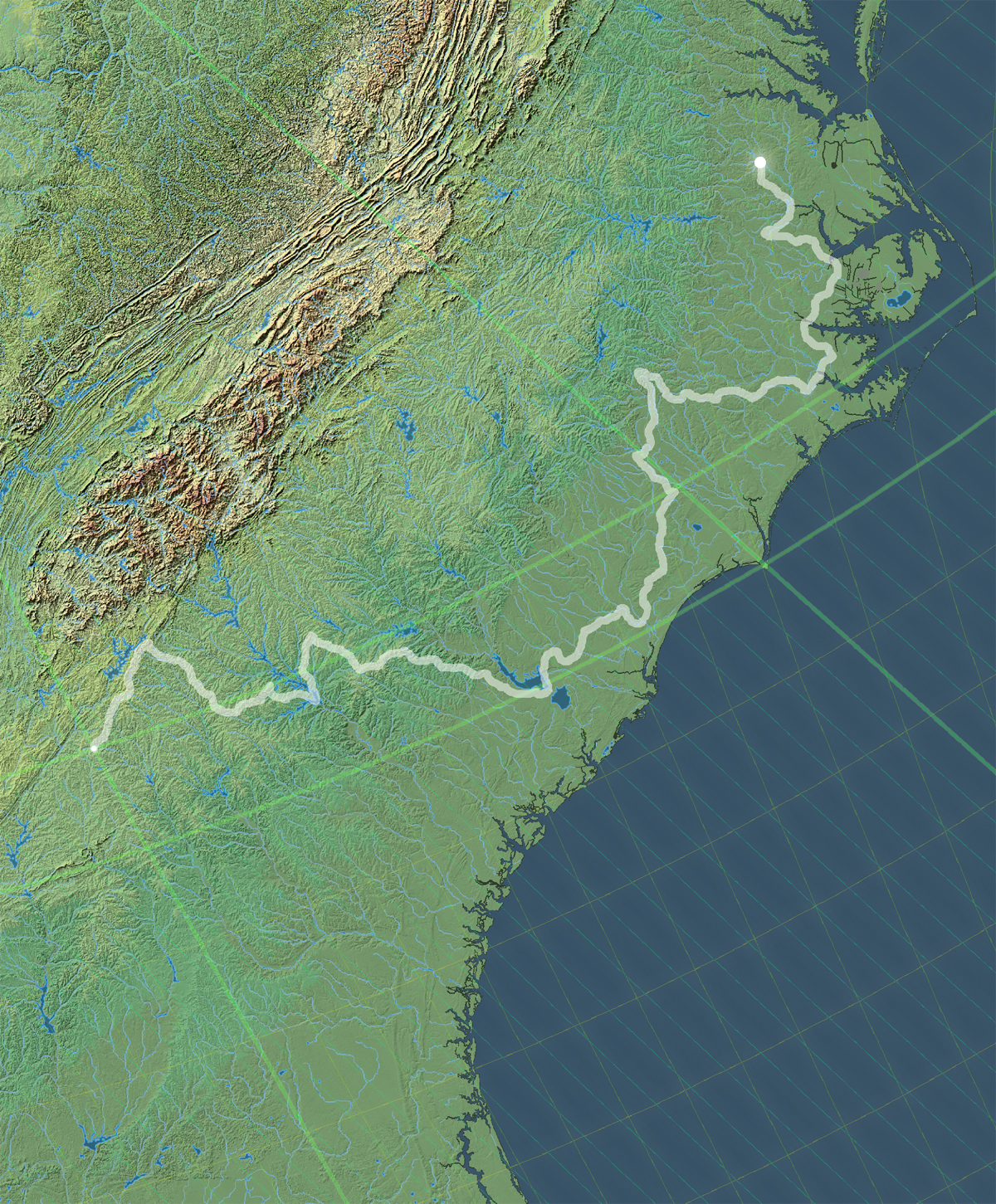
While watching the news, I noticed a curious gap in a weather map. The clouds seemed to be consciously avoiding a very large region. When I say that I think visually, I really mean it. This prompted my imagination to follow some curious tracks – musing on fiction and on a dozen different kinds of maps.

Most of my thinking eventually takes the form of a map in one way or another. I could blame Tolkien if this hadn’t already been my habit long before I read any part of his legendarium. So – if the clouds were deliberately leaving at least three States off their itinerary – Why? What’s happening in there anyway? What are those clouds afraid of?

Two maps grew out of these questions:

Mantoacmantoac map

|

|

|

|

|

|

|

|

|

Once I have three novels* off my To-Do List, the saga these maps describe will be the next one on. There are two dozen or so presently hidden layers in the Photoshop file that amount to a literal – visual – outline of the story in question.

My method of musing probably wouldn’t work for everyone. There are a few people I can think of that might find this an odd wending. Storytelling as an art reflects how we see the world and/or how we’d like to. Sharing a story is a very different process than crafting one.

Posts here don’t have maps in their origins. I’m going to save myself the time of wondering what those might look like.

* Working titles: All We Now Hold True, A Song Heard in the Future, and Air Raid Sirens
And, yes, each has at least one map associated with it.
_
☿℞

All fled – all done? No. Not yet begun…

1658478_10152339202313623_868086721_oAn announcement was recently made so a post here that I’d expected to make next month can be early. (That might make up for missing a post or two while away at Dragon Con and Space Coast Comic Con.)

An opportunity to contribute to an upcoming anthology of Cthulhu-related stories was shared with me by my business partner and coauthor – Leanna Renee Hieber. A gentleman with whom she’s worked in the past, one Mr. Simon Berman, was collecting work for the project.

There were several topics to choose from and I selected the one that most closely matched a long-standing interest of mine. If you’ve been reading Surfing the Zeitgeist, you may even be able to guess. Ms. Hieber chose a different but no less compelling subject.

Guessing, however, won’t have to last very long. There will soon be a kickstarter effort to bring the anthology to a shelf near you (hopefully one in your own home library). Once that’s a success, you can confirm your suppositions about the topics selected. Until then, enjoy taking the role of paranormal investigator.

This was a very enjoyable project and also exciting. I may not yet have arrived but I can see the road signs.

12047141_10153708176873623_7567513244212927324_n