
Seriously?…

seriously

Whether called reboot, reimagining, or remake – there is, at least, one almost guaranteed reaction when Hollywood makes the announcement: There is nearly always complaint by loyal fans of the quintessential (older) version.
And when the film is released, it never plays to a completely empty theater.
Nearly 125 remakes were released between 2003 to 2012. That would be one a month, on average. Said remakes brought in a combined box office gross of $12 billion.
The explanation for the remake frenzy is “the foreign market”. I’m not sure I buy that. Surely folks in The People’s Republic of China (中华人民共和国) get just as bored by/tired of an endless chain or rehash as anyone else.
I think… I hope — that the people of the Republic of Nauru (Naoero) are desirous of new and original ideas and content.
Hollywood’s emphasis on the reliably bankable is a polite way of saying they are risk-averse. Similarly, when they want it accessible, that means they don’t want to challenge or offend.
But personally, I enjoy having my assumptions challenged and my knowledge expanded. A film can be both confusing (at first) and offensive (if for effect) – so long as the end result is teaching a valuable, needed lesson. And, yes, I do expect a message from entertainment. If there isn’t to be a message – fireworks displays are free and generally ubiquitous during blockbuster season.
Nearly all work by the motion picture industry is based on brand & franchise now. There were times – and not so very long ago – when filmmakers were just as interested in story and moral as I still am.
The above Hollywood preferences may have contributed to the opinion – voiced by many – that Hollywood is out of ideas. That’s absurd. There are new novels being published every month.
The solution is clear! Reward storytellers.
Don’t go a see a film unless the trailer, pre-release press, and/or critical reviews illustrate that said film presents a new idea.
Buy a book instead.
You probably know an author. You may be one. We craft stories that we feel make important observations about life and may offer the equivalent of life-hacks within our work. Sometimes telling these stories means a sacrifice or two in the life of the author. There are tales behind the tales a reader may never know. When you hold a new book, and before you start reading, try to imagine the heroic journey the author (along with her or his allies) have already been on to see it safely into your hands.
The novel is a kind of gift-with-purchase. What you pay for is that unknown adventure the author has been through to tell you something potentially important.
If enough people do this – buying a book Instead of seeing a movie – some studio is bound to option a story you’ve read. We won’t have wasted money on a disappointing two hour retread. We also actually own a book as an added bonus.
Everybody wins! You, the book store, the publisher, the editor, and the author all get to smile. The film executives will wonder why – until the buy and read it too.
Coming soon…

Tilting at the Windmills of My Mind…

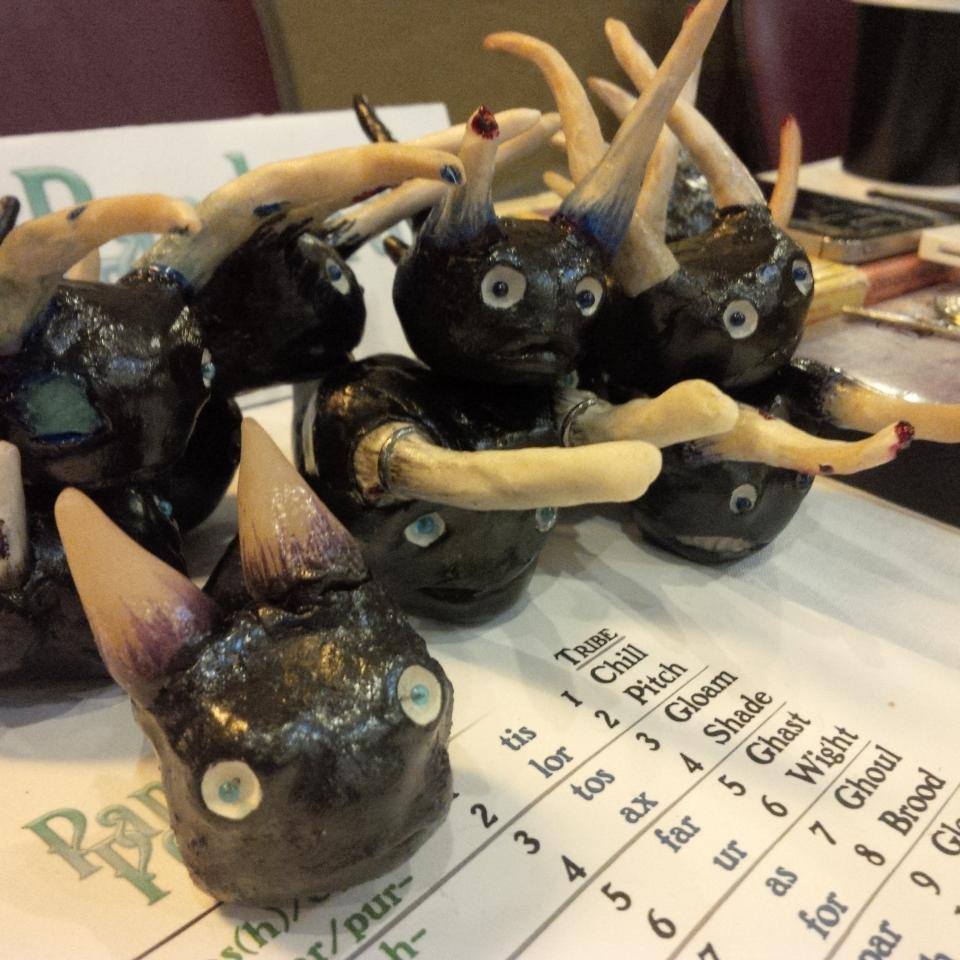
As Pandora’s Pets are not made singly, except in the case of a commission, it isn’t so easy to say precisely how long each takes to make. They take as long as they need. Their creation is a collaborative process with Leanna Renee Hieber, who gives them their individual details and augments their personalities. We haven’t precisely timed that process either.

PetsWhen each is finished as a work of art, they’re not fully complete until a customer adopts them. There’s a procedure when each is sold that we consider vital. Every one of Pandora’s Pets needs a name. We keep a record of the name of each Pet.

To be honest, however, I didn’t want to have a list containing common or ridiculous appellations. This meant there needed to be a process. Within the lore of Pandora’s Pets they’re meant to be quite ancient, somewhat otherworldly creatures. What follows is a (mostly) complete account of how the naming chart was created (in January of this year); this isn’t entirely random facts:


circa 3800 BC
Ur was a Sumerian city-state and served the Mesopotamian culture as an important port. Since the end of that period, silting of the Tigris and Euphrates Rivers have added almost 200 miles of land between the Great Ziggurat and the Persian Gulf. At its peak, however, Ur was immense in terms of both scale and splendor.


c. 832 BC
The First Temple in Jerusalem is begun. Myths about its construction probably began about this time, too.


c. 1100
The Scots adopted the word glomung from Old English. It became gloaming and still means twilight or dusk. In some parts of Scotland it may also mean dawn.


1583
By this time, the esoterica about King Solomon‘s included the recruitment of 72 spirits, each of whom had special talents. Johann Weyer and others attempted to list them all. The lists don’t match at every point.


1821
John Keats invented the word gloam for his revision of the ballad, La Belle Dame sans Merci.


Thinking about these things and along these lines produced the following chart:

d20: Name Tribe
1 Kut(h)- -as(h)/es(h)- -tis Chill
2 Tel- -par/pur- -lor Pitch
3 Ur- -kah- -tos Murky
4 Kis(h)- -el- -ax Shade
5 Der- -gaht- -far Ghast
6 Ad- -veh- -ur Wight
7 Jem- -ix- -as Ghoul
8 Eri- -ib- -for Brood
9 Ak- -daht- -par Gloom
10 Es(h)- -sal- -eth Frost
11 Gir- -o- -gos Gaunt
12 Lag- -bey- -las Weird
13 Lar- -mu- -mon Cloak
14 Shu -ru- -ius Bleak
15 Har- -neh- -ith Ghost
16 Din- -day- -son Dread
17 Bad- -ara- -thin Haunt
18 Is(h)- -tra- -ion Eerie
19 Kua- -euh- -eus Qualm
20 Bad- -has- -os Cloud

Column № 1 – represents the result on a 20-sided die. A different, color-coded die is used for each subsequent column at point-of-sale.
Column № 2 – The names of some of civilization’s most ancient settlements (or syllables thence) became the prefix for each Pet’s name – to suggest extreme age.
Column № 3 – The middle of each Pet’s first name is pure invention to serve as a bridge.
Column № 4 – The suffix of about thirty percent of Solomon’s helpers are also suffix for the Pets.
Column № 5 – The Tribes to which each Pet may belong are called by synonyms of gloam and other spooky 5-letter words.

The next batch of Pandora’s Pets will mean there are more than 100 of them in the world! As making them helps both Ms. Hieber and I smile – and then the people to whom they’re offered for sale – that’s an already uncountable number of smiles that wouldn’t have happened otherwise.

Note: While making this post ready my entire computer froze. I’m attributing the smile that resulted from not having to start over to the Pets as well.

Keep ’em flying, son…

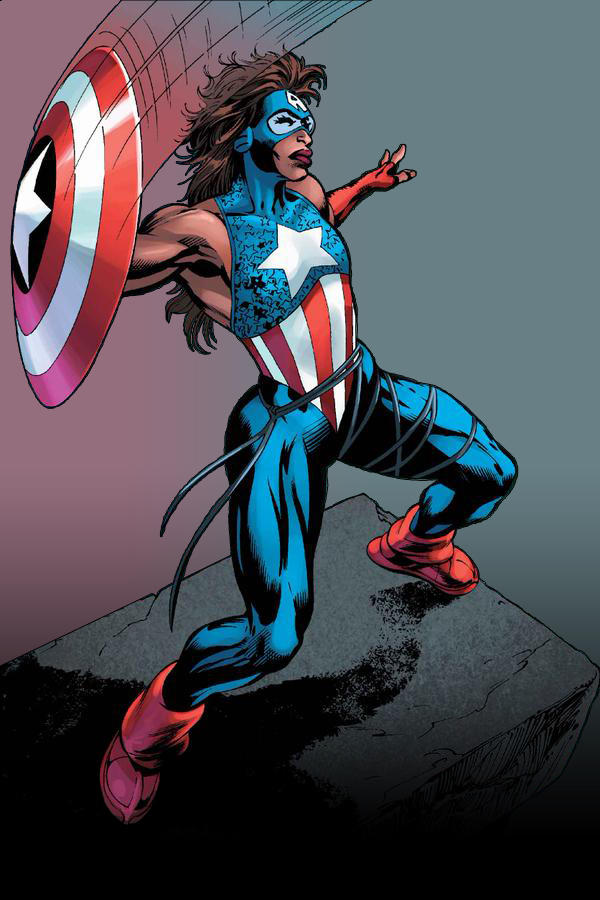
Marvel Comics announced last year that a female version of Thor would feature in a new storyline. Given that an African-American would assume the mantle of Captain America was announced at about the same time, it seems a reasonable suspicion that Marvel executives might have issued a “More Diversity” directive.

There was a degree of push-back on both Thor as a woman and Cap’ as a black man. I didn’t agree with the opposition to either character and still don’t. I’m very much in favor of stories that encourage an understanding of diversity. There is great value, particularly in entertainment that appeals to children and young adults, in a reader finding heroes that are readily seen as “like me” by said reader. This should not be limited to fiction either.

But I do understand why there was opposition. People are very resistant to change. In fairness, I don’t care as much about the dozen other characters who have taken up Captain America’s shield. If it isn’t Steve Rogers

So, these additions to the Marvel Universe met with immediate and vociferous objection from many – including, in the case of Thor appearing as a woman, from fauxminist Joss Whedon. If there was a memo, he seems to have missed it. According to Variety, the creator of Buffy and director of Avengers said via Twitter:

A female Thor? What the hell makes them think THAT would be cool?”
July 15, 2014

The likelihood that I’ll meet Mr. Whedon to discuss this seems a poor one. As he identifies as an atheist, I’m not sure his negative reaction to Thor as a woman is the one in which I’d most be interested. There are practitioners of Ásatrú (i.e., those who actually do worship Thor and other members of the Norse pantheon) and I’d rather chat with them about Asgardians in comic books – should I ever meet any. A far, far distant second place would be actual readers of Thor comics.

I was able to speak with a vocal protestor of the Thor-as-a-woman panic (who will be anonymous in this entry – as a courtesy). The objection boiled down to his confessed inability to glean as much meaning from a story when the central character is female. In essence, that renders every fictional woman an Unreliable Narrator. It would not be fair to suggest that this anonymous opponent of the female Thor went on to say the same lack of apprehension applied to true stories told by non-fictional women. He did not. And I hope not.

With the prospects of Ms. Thor, the objections seemed to go deeper and in a different way than Black Cap’. There was far more bile and venom thrown up about a “God” of Thunder portrayed as a woman. Nevermind that at least three women have lifted the Hammer in past comics. Fans don’t seem to have objected as much – if at all – when Loki appeared as a woman. (And why was that okay? There’s an entire other set of questions that could raise.)

Isn’t it likely that the gender and/or sexual preference of fictional persons is rarely the point of the work of fiction in which they appear? Tales are made of emotions, decisions, and words. English, unlike such languages of Greek and French, does not gender its words. Why, then, is our thinking so gendered? When we are defensive, what are we defending? And is it really under any attack?

I learned in preparation for this post that the Thor-aswoman title is selling better than the Thor-asman issues. It was also news to me that the Captain America of at least one fictional future is Danielle Cage (the daughter of Jessica Jones and Luke Cage, a.k.a. Power Man).

danielle-cageIll have to put Ms. Cage as Cap’ on my reading list.

Separated at birth…

Questions raised by science fiction – good or bad – include “Where do we come from?” and “Where might we be going?” Sci-fi may also ask for a definition of humanity, particularly when at its best. And much of the genre is a depiction of the Cosmos, its possible meaning, and our role within it – if any.

When ΨΦ (psi phi) interprets humanity as a specific code of behavior or paints the Cosmos as demanding such adherence, all of this together begins to resemble religion. I have been developing a science fiction story that treats on some of this territory. During this musing I find myself wondering why science fiction usually tends to wheel away from religion.

There are exceptions, of course. For most of the ‘90’s both Star Trek: Deep Space Nine and Babylon 5 dealt with religious beliefs while telling sci-fi stories. In the following decade-plus, the reimagined Battlestar Galactica did so also. But that’s not quite the point aimed at here.

A religious story set within a sci-fi universe or a sci-fi plot with the trappings of belief goes only half way. I’m newly fascinated by the concept of a novel that is truly about both – or at least sparks a debate about which kind of tale it may be.

All We Now Hold True” is the working title for my offering to Star Trek readers – both old and new. In addition to an attempt to build the bridge alluded to above I seek to build a bridge between original and relaunch.

The Vulcan Language Dictionary (VLD) lists nearly a dozen deities from the pre-Surak period. In pre-Reform Ancient Vulcan a pantheistic society is shown in several existing novels. The planet giving rise to that culture is generally painted as a global desert. Measured by their gods, the Vulcans are obsessed with the dichotomies of war and peace and of fertility and death.

The presumptive answers they might give to the foregoing questions are: “We come from conflict. We may never truly escape it. At our best, we can survive as long as possible. What else can be done?”

In short, an environment of severity will raise severe people.

But what if that’s all not the whole truth? Some personal experience denies this being a reality. My premise and hope within fiction says otherwise, too.

kau

Please Note: This entry is a day late in terms of my normal posting schedule. I’ve spent most of the day easing the transition of the pet cat I’ve had since 1999. The premise of this entry was planned before I knew today would be Lily‘s final day with me. I find it strangely fitting that her passing raises a few questions related to those I’ve mentioned here. But the corollary of this post’s title is an intentional reference to how much I’ll miss her.

But Thinking Makes It So…

As part of his forward for the 16ᵗʰ topic treated by The Visual Encyclopedia of Science Fiction (Harmony/Crown Books, US; Pan Books, UK – 1977) Larry Niven stated that telepathy, psionics, and the like could result in poor writing and suggested that it is the limitations an author sets on such fantastic powers that makes them interesting. His caution was one of avoiding wish fulfillment.

There are similar arguments made about souls and any sort of after life. Devising a series of tests for the existence souls and what fates may await them could be more difficult than scientific analysis of psychic prowess. Nikola Tesla performed an experiment to do just that. Would Mr. Niven make a similar argument about wish fulfillment here too?

The wish made manifest is one of the components of achievement. Isn’t what we do and make how we craft our sense of meaning and value? What tests may show often matter less than the results of having some belief in something eternal, particularly in conjunction with those crucial senses.

I look upon death to be as necessary to the constitution as sleep. We shall rise refreshed in the morning. Finding myself to exist in the world, I believe I shall, in some shape or other always exist.”
Benjamin Franklin

In an interview in the San Francisco Examiner (26 August 1928), Henry Ford said the following:
I adopted the theory of Reincarnation when I was twenty six. Religion offered nothing to the point. Even work could not give me complete satisfaction. Work is futile if we cannot utilize the experience we collect in one life in the next. When I discovered Reincarnation it was as if I had found a universal plan I realized that there was a chance to work out my ideas. Time was no longer limited. I was no longer a slave to the hands of the clock. Genius is experience. Some seem to think that it is a gift or talent, but it is the fruit of long experience in many lives. Some are older souls than others, and so they know more. The discovery of Reincarnation put my mind at ease. If you preserve a record of this conversation, write it so that it puts men’s minds at ease. I would like to communicate to others the calmness that the long view of life gives to us.”

KarmikPrinciple2Franklin and Ford were both (arguably) great. Both the lightning rod and automobile are still in use. These views very likely helped both inventors in being able to accomplish their work. It seems to have reassured them and helped them recharge.

It might matter less who we have been in past lives than who we may be in future iterations. Imagine a reliable method of access to what we’ve learned so we can always hit the ground running. I could put it on my perpetual calendar that I had an appointment with Dr. was-Franklin and Mr. was-Ford on 17 June 2373 in a little pub called The Silver Lining, deep in the Oort cloud . Imagine We Can Remember It for You Wholesale to the Nᵗʰ degree.

“I’ll get back to this.” Scheduled.

There is no Reincarnation Axiom. Tesla’s experiment did not substantiate transubstantiation. It doesn’t mean it hasn’t happened; there was no proof either way.

Be diligent in what you wish for. Anything can happen.

infinity sergeant copy

i⁽ᵗ/ᵉ⁾ = :)

Postulate: There is a very easy way to determine if one has an artist’s soul.

The formula/title of this entry presented in words would be – “(the) imaginary, raised to the power of time divided by energy (or effort), yields a smile“.

If – while engaged in the act of creation – one smiles, one is likely an artist or may “soon” be.

“Soon” is a variable. The specifics of the act may also not be a constant. Both the process and product might seem radical and/or irrational. If the creation, intended or not, proves smile-inducing – should it not count as art?

Pandora’s Pets are part of my art and process. As individual creations, I smile at each one as they evolve. I have been fortunate enough to sell nearly 50 of them – not counting the Pets out on consignment.

As a group – and as the subject of an evolving “mythology” – they satisfy the need to remind myself of patience, innocence, and hope. They will also be featured in an illustrated book for inner children (in progress). It deals with emotions and stars Pandora and her bestie, Hope.

Pandora's Pets 3

Any customer can have a car painted any colour that he wants so long as it is black.”
Henry Ford in his autobiography, “My Life and Work” (1922), speaking about the Model T in 1909.

The Pets‘ horns and black coloration are obvious but they are intended and presented as creatures of hope (ἐλπίς, or elpís, in the original myths). Their appearance and presence in my own mythology probably dates to about my first birthday during college.

I can no longer say for certain but they might have stemmed from “personification” of attention to detail. The tiny and good devils in the detail, if you will.

The most frequently used word regarding Pandora’s Pets when I am presenting them to potential customers is “adorable”.

They just make me smile.

The Fault — Is Not in Our Stars…

A component of being a purist may be thinking that the science in science fiction should be reasonably valid and the result of some research. If so, then I am at least partially a purist. If a starship can go anywhere in the galaxy in a few seconds, the accomplishment of space travel becomes quite meaningless. How do we preserve a sense of awe? How can new science fiction inspire the next generation of scientists and engineers?

In a less lofty capacity, if a writer won’t do a bit of research to make the science feel correct is it fair to assume they might stint on other details? Yes, it’s true that the emotions and growth of the characters is the vital core of fiction. How the main character feels may be the best way to capture a reader’s desire to identify with her or him. Comparing that character at the start of the tale and its conclusion provides the essential meaning of the journey.

We’re hard on our potential fictional heroes for a reason. They are more than reflections of our selves. They can – and when done best, should – mirror who we hope to be. The worlds in which they live illustrate where we hope to live. In rare cases, sci fi heroes can help us get there.

Science fiction can serve to criticize the aspects of our society that warrant correction. When the emphasis is on good science, the genre includes a different rationale than some others: that the meaning of our journeys can be understood. There are truly cosmic answers that can be had.

If the rocketship can reach the Moon in less than ten seconds, the landing pad can be green cheese. In “All We Now Hold True” it matters How Far and How Fast. Part of the story is a race against time.

rom-halan-draftDescriptions in prose and by equation need not be in conflict. It has recently been pointed out to me that some of my explanations of formulæ can wax poetic. Balance is part of my preferred aesthetic, whether in composition or equation. Science and math – like hue and light – underlie representations of beauty.

sic itur ad astrathus one goes to the stars

Into the Blue Again…

all we now hold trueThe phrase “there is nothing new under the sun” has always bothered me. Until beginning this post, I did not know it was Biblical. It reads in full: “What has been is what will be, and what has been done is what will be done; there is nothing new under the sun.”

It always seemed so discouraging. While I was a teenager, it almost offended me.

Similarly, when I was growing up, I had a profound dislike for some of the lyrics of All you need is Love.

There’s nothing you can do that can’t be done…”

I cannot say when I learned the value of inverse statements. Second guessing Ecclesiastes is not the aim here but the Beatles may have been making the point that if one person can do something – even if that person is the only one capable of the task – it is not impossible.

Given a choice between the two, why wouldn’t we choose the more bolstering message? There’s too much in the zeitgeist that suggests there are no solutions so any effort is without efficacy. Lethargy’s a Hell of a way to live; acedia was once included among the Deadly Sins.

Last week’s post was part tribute to the memory of Leonard Nimoy and part notice of encouragement to try something about which I’ve been musing for perhaps my entire life. (I cannot be sure. I don’t remember the very early parts.)

All We Now Hold True is meant to shine the light of Vulcan through a new prism – at a new angle – and get different colors and perspective. Perhaps I’m missing the point of the verse but my work is new under the sun because only I can do it. I am new under the sun – due to inspiration and in hope of returning the favor.

It’s easy.”
John Lennon

ek ik pakashogau etek u’yeht’es…

There is nothing new or shocking (to those who know me at all if not well) that I have been a Star Trek fan for as long as I can remember. And while I will not claim to have been to Hell and back, it is probably fair to say that I experienced some trauma during my “formative years”.

I delayed my initial post regarding Leonard Nimoy’s passing by a few days, partly out of respect and partly because I needed time to process. I am still processing. It was his portrayal of Mr. Spock that ironically provided a much younger me with a sense of emotional stability.

The Vulcan way is part of a body of fiction, of course; I do not embrace it as a way of life. It merely informs some of my “navigation”. In all honesty, though I have a lasting affection for Star Trek, it never presented any alien species as a whole and complete culture.

Klingons, it could be argued, are more richly detailed than any others but a ritual-of-the-week and appropriation of Shakespeare makes them just the boldest cypher of the lot. Vulcans run a close second oddly enough. All of the alien cultures started as metaphor and have become stereotypes in their own right.

Within the past few days my ‘processing’ has led to adjusting the schedule of my novels-in-progress. For a very long time I have wanted and needed to write for Vulcans as more than computers on legs from a volcanic desert world.

My very good friend, Leanna Renee Hieber hurried to tell me of Mr. Nimoy’s passing while already rushing between her programming commitments during AnachroCon. She knew what it would mean and took special care to break the news in a kind and gentle way – rather than it coming by way of a stranger’s shouted announcement amid convention chaos. As she made her way to the next panel, I drew a portrait of the actor who played one of my heroes:

image

His final words/Tweet compel: “A life is like a garden. Perfect moments can be had, but not preserved, except in memory. LLAP”

Spock’s people are known for their respect for Infinite Diversity in Infinite Combinations (k’lalatar prkori k’lalatar prnak’lirli) and the IDIC symbol. Gene Roddenberry stated the symbol “has great meaning to all Vulcans”. He indicated that it was somewhat comparable to a religious symbol. Outside of fiction, the symbol itself is 47 years old.

image

Comprehension and embrace of diversity still eludes us. Some efforts at celebration of diversity can cost us opportunities for unity. We still need the IDIC.

If nearly every Vulcan we have ever seen is just like Spock why would they venerate diversity? How could it mean so much to them if they were not natively host to quite a range?

All this to say: a novel concerning Vulcan memory, truth, and culture has moved to top priority – at the urging of Ms. Hieber, who will be coauthor of the work. The working title is “All We Now Hold True“. (In the Vulcan language, that is the title of this blog post. Thanks to Britton Watkins for the translation.)

Please do feel invited to Follow, Like, and/or comment.

Paradox need not apply…

Ordinarily, this blog updates once a weekon Monday. I didn’t think it was fair to stretch The Three Laws of Magic over most of April. Next week’s post may be delayed by a day or two.

The supposition that the Earth might be spherical was being examined at least 2,500 years ago. It took 80% of that time for circumnavigation of the planet to become possible. It is now commonplace. If satellites in orbit are included, it’s a constant. Nevertheless, there are still people who believe the Earth is flat.

Despite some progress, some of which includes true high points in thought, our oblate spheroid planet still harbors a discouraging spectrum of prejudice. In 1941, some American leaders believed that the Japanese were too inferior to Caucasians to have successfully attacked Pearl Harbor. Clearly, they’d have required the help of the Germans. That was nearly 75 years ago – but embarrassingly recent.

Religious and gender-based prejudice is not new. Laws that attempt to control the behavior of “The Other” have existed since there have been laws. The timeline for one side being brutal to another side – of any stance or argument – is incredibly long. Do we have to share a world with luddites and bigots? Probably. And I will probably (and ironically) continue to look down on them. There is, however, no excuse for We as the Whole to give up trying. The weakest link in our enlightenment chain might always be our education system. Good enough is not good enough.

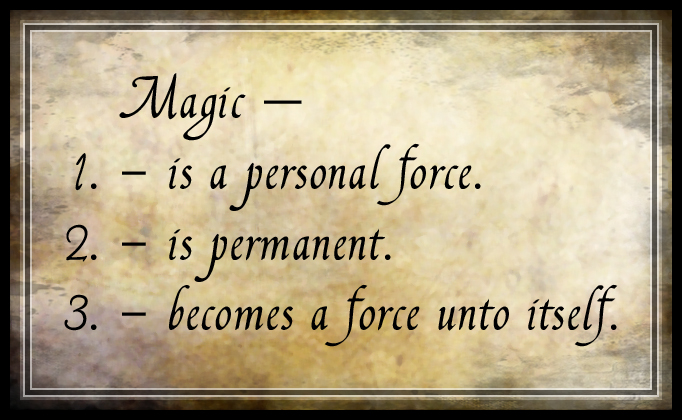
All this to introduce the Third Law of Magic. If you’ve recently been following this blog you know the First Law is that “Magic is a personal force”. At the most basic level, that means that magic begins with a single person’s energy. The Second Law is that “All magic is permanent.” Multiple layers of permanent magics may have a range of results.

Magic becomes a force unto itself.

Laws of MagicNone of this is supposed to be science and this musing of mine is background material for most of my fiction. That said, we do have it within our power – with care and consideration – to improve our thinking. It may be true that ill-conceived notions are cars that never leave the racetrack. Accepting it as a truth makes it a foregone conclusion.

There have been a few novels I’ve read and slowed my reading pace when there were just a few pages remaining. When a good story is about to present a hopefully good ending, I like to savor right up to “The End”.

I’d like that to be more readily possible in the non-fiction section of the Corpus Humanum. As I mentioned in this blog on Feb. 2, “…centuries without proof of a hypothesis is not proof of the antithesis.” The word “impossible” should be reserved for violations of the Laws of Physics.

Please consider yourself invited to Comment, Like, and/or Share.