sic itur ad astra…

Note: There’s been a longer than normal interval between posts as there was more than usual work involved with this one.

Science fiction is very probably my first genre love. As readers of this blog already know, this affinity began with Star Trek. Given that, it won’t be surprising that my taste in scifi is generally best served when the setting is against the backdrop of a human interstellar presence. My story set in ancient Greece has been replaced as a priority with a novel-in-progress that takes place almost 50 light-years from Earth and roughly 550 years in the future.

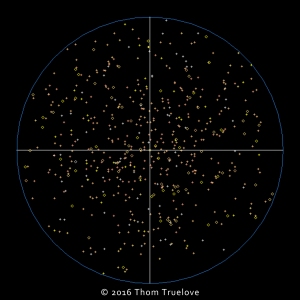
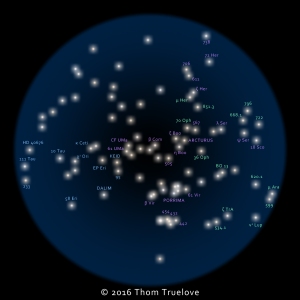
Part of my outline process usually involves a map of some sort. This scifi effort (working title, Astral) is no different. By making a chart of most of the stars within 50 ly of our solar system, details about the future politics of humanity came into sharper focus. This is as much a part of the world building for the tale as FTL travel, terraforming, and human genetic engineering.
Stars

The volume around Earth at the given radius includes at least 583 star systems. There are red and white dwarf stars not shown in the first chart. Similarly, the stars shown do not double up with regard to arity (binary, trinary, and so on). If habitable worlds may be assumed to orbit stars like the Sun, about 10% ±x of these systems could support life. It should be noted, since extrasolar discoveries are being made “all the time”, no real effort was made to match exoplanet reality.
Settlements

A presumption was made that faster-than-light travel would have limitations based on mass and material composition of any ships involved. Relatively instantaneous hops of 20 light-years or fewer are the standard.

This decision puts ten systems with potential for colonization within direct reach of Earth. Each colony would then become a waypoint for the next tier of expansion. The result would be a web of worlds, each having a neighborhood of 10 other colonized systems on average including 2 colonies of their own.

The first question after making these determinations was, “How far from Mother Earth would humanity spread before thinking of their new home world as more important than the origin point of the species?” The answer lay as much with history, sociology, and psychology as with astrophysics. The critical star turned out to be Xi Boötis (ξ Boo, “zai boh-oh-tis”). Two hops from Earth, with 70 Ophiuchus in between as the staging point, Xi could have almost as many imperial opportunities as the initial starting point of the human race.

The expanding network of worlds colonized from Xi (and the colonies growing from those, etc.) would reach to between 20 and 30 more systems by the time humanity began to push outside the 50-ly radius sphere. If such a significant branch of colonial propagation were to stage a revolution, Earth society could be thrown into a panic. What’s more, other factions might seize the event as an opportunity for their own independence – to one degree or another.

All of this is the backdrop of Astral, with Xi and its extended family as the new hub of human destiny in space (for the time being) and two other, though smaller, federations as political entities separate from Mother Earth. Apart from ME, the factions are Federalist Arcadia* (sharing in etymology with Arcturus, one of two “named” stars among those claimed from Xi), the Hamarchy of Keid*, and the Ophiuchid Cantons*.

So, what’s the story? To that I’ll cryptically reply, “Imagine Plato meets Poe.”

* © 2016 Thom Truelove


fellow travelers…

On or about Sept. 28, 1991, Dr. Carl Sagan and Tenzin Gyatso (བསྟན་འཛིན་རྒྱ་མཚོ།) met. I am neither a scientist nor a theologian but both of these men have my respect. The former is most broadly known for Cosmos: A Personal Voyage and the latter as the 14ᵗʰ Dalai Lama. The approaches to the subject of understanding the universe they each took are different but the mission are one and the same. The meeting was recorded, at least in part, and while the video quality is poor but the message is strong and can be found here.

Whether we have any formal training in the fields of science, religion, or philosophy or not, all of us share the goal of comprehension. What is the cosmos and why do we find ourselves in it? There are pragmatic, non-philosophical answers to pursuit of this knowledge.

In one of the final interviews of Dr. Sagan, he was asked to comment on the consequences of science and technology on human civilization. In part, this was his answer:

“And if we don’t understand it, and by ‘we’ I mean the general public, if it’s something that – ‘Oh. I’m not good at that. I don’t know anything about it.’ – then who’s making all of the decisions about science and technology that are going to determine what kind of future our children live in?”

Two years before his death, Dr. Sagan gave a lecture at Cornell University and included a philosophical reflection on an already well-known photograph taken of Earth by the Voyager 1 space probe. This is often called The Pale Blue Dot speech. It is truly worth a listen. Essential.

Just a phrase or two might offend some but, if so, it might be among those who have decided they can learn nothing from science or scientists. Nevertheless, the message and emotional tone of Dr. Sagan’s plea should be universally held – regardless of any other ideology at least in the opinion of this author. In very few words, relatively speaking, this stands as a summary of what being human means and could mean. From the moment I first heard them they also stood as something of a miracle.

To paraphrase a definition of miracles I once read, they’d be inexplicable events that inspire us to do more/better. Put this way – science, religion, and the individual quest for meaning with which we’re all involved might all include a miraculous experience along the way. With this two-part formula for a miracle each of us is able to define and find our own.

Earth and Song

As far as is known, the Dalai Lama hasn’t commented directly on this almost poetic prompt for humanity to acquire an improved perspective. However, the following opinion from him seems ample cause to presume the two scholars would be in agreement.

“Whether one is rich or poor, educated or illiterate, religious or nonbelieving, man or woman, black, white, or brown, we are all the same. Physically, emotionally, and mentally, we are all equal. We all share basic needs for food, shelter, safety, and love. We all aspire to happiness and we all shun suffering. Each of us has hopes, worries, fears, and dreams. Each of us wants the best for our family and loved ones. We all experience pain when we suffer loss and joy when we achieve what we seek. On this fundamental level, religion, ethnicity, culture, and language make no difference.”

As a miracle results – by this definition – from an inexplicable source, it is the effect on our motivation that matters more and whether and how we allow ourselves to be moved and motivated. I don’t see any conflict between religion (“Be kind whenever possible. It is always possible.”) and science (“Somewhere, something incredible is waiting to be known.”). I don’t see any reason why they can’t both have their share in the miraculous. It’s a big universe.


on your marks…

The ouroboros can represent the cyclical or even the infinite. I wonder though – does the snake ever think to itself, “It seemed like a good idea when I got started.”

There is a mythical account of punishment imposed upon the immortal soul of Sisyphus, king of Ephyra. His torment in Hades was to perpetually move a large stone to a hilltop only to have it roll back down after each attempt. When I was first taught this story I remember asking, “Why doesn’t he just stop?” I was told that such things were part of the nature of Hell. I thought, “Well, that’s stupid.”

The tale may serves as a lesson on the dangers of obstinacy or in how to discern a no-win situation before too many resources have been lost. The moral of this particular story is also warning about hubris and other character flaws.

During the research for and early writing of A Song Heard in the Future there have been three problems for which I’ve been seeking solutions: 1) In ancient Greece, the practice of slavery was not only ubiquitous – none of the city-states could imagine a world without slaves. They were considered a necessary part of society, 2) the more loathsome custom of infanticide of the unwanted also seems to have been prevalent, and 3) the treatment of women had them treated as all but indistinguishable from cattle.

In Song, I have been attempting to make the characters more real and accessible. One mechanism has been the removal of monsters where possible. For example, it seems very likely that the fabled Chimera was not a beast with three heads but a pirate ship. Another part of the process has been to build a synthesis of the often contradictory plot threads in the shared universe (or common agora) of the mythological canon. Could a certain graceful spinner have been married Chiron before being present when Teiresias gained the gift of prophecy?

Any true hero would make the three significant injustices his or her cause to end and right. Heroes have to be more than marginally better than the society that produced them. In a purely fantasy setting (such as Clash of the Titans or Hercules) writers may ignore these issues.

As an author, I cannot in good conscience write a story in a setting that has these and other problems without said story being about proper address. With due respect to the tail-devouring snake, I won’t be giving up on Teiresias; there’s too much potential, too strong a message in the telling. I’m determined. The collective journey of heroes is, as it turns out, a staggered start. As my definition of a hero is somewhat strict, and perhaps superhuman, the song will have to be heard in the future.

Luck and inspiration has saved months of research and the purchase of several reference books from being in vain. I recalled a conversation I’d had with a friend about sociology and human nature. We’d concluded that very few notions (construed as race cars) ever leave the track. What resulted was an epiphany about a how I might craft an unexpected new tack on a cult sci-fi setting that’s long been a favorite of mine. Even more pleasing – the value of my work on Song can be included without much revision at all.

Many novelists and editors alike will tell you that crafting a story is about the choices made. Prioritization of one novel over another is not giving up. Simmering one while another’s on the boil is part of the process. An illustrator I am privileged to know once gave me good advice: the best outline for a story leaves the audience with no plot-holes to point to and no questions unresolved.

me-ta

I’m very confident that the new idea will be enjoyable to write and to read. I’m equally certain I will solve the problems mentioned above and be able to return to the novel set in ancient Greece. One has and will inspire the other.


💡

What would Master Zhūang say?

In the opinion of this author, there is not as much value in dream dictionaries as I’d like. One can provide assistance to someone in the interpretation of their dream experience but it seems inadvisable to dictate a specific meaning for each symbol. At least four factors govern the meaning of a dream symbol to an individual dreamer, not the least of which being the dreamer’s knowledge and opinions formed during waking life. The other factors depend on circumstance and culture. An anchor may mean something entirely different from one dream to the next ὄναρ or in another 梦想. And certainly all of these would represent divergent things to someone who makes or uses anchors as opposed to someone who doesn’t.

Similarly, there are certain assumptions put forward in psychology about the meaning of doodles. Circles, for example, are said by some to indicate a desire for a more peaceful or organized state. How each person thinks of them – what they may represent during and after drawing a few – is the same as dreaming. Probably during my elementary school years the circle began to serve as the symbol of introspection. This has gradually evolved closer to the idea of an orbit – such as an electron around the nucleus of an atom held in place by electromagnetic force. A moon in the gravity well of a planet, if you will.

The moon, planet, and gravity well as a set represent my understanding of myself and the world around me. The orbital path illustrates that maintaining comprehension is an on-going process. Additional satellites each indicate a separate interest. If I lose interest in something, it has reached “escape velocity”. Those ideas that come back seemingly seasonally to distract me are comparable to long-term comets. Anything not “in orbit” is outside the range of interest. It hasn’t caught my attention – or, in this metaphor – I haven’t caught interest in it yet.

Since I became aware of the word affinity I’ve had an affinity for it. From the 1600s to the present day, it has been used to describe an attraction to something. During the three centuries prior to that, affinity was used to refer to a relation by marriage. Ultimately, the term derives from the Latin affinis or ad + finis, meaning “to the limit or boundary of” – in essence, the state of being adjacent. Affinity is a handy explanation for why people do what they do: they’ve an affinity for it, whatever it is.

Just as the definition of affinity has evolved – symbols change their meanings over time. The anchor in future dreams may have little in common with interpretations today. Literally today, in the field of psychology, there is debate on the veracity of the theory of ego depletion. (For those who are more curious, consult next month’s Perspectives on Psychological Science.) Mention is made of it here because this could signal an evolution in certain theories of human behavior.

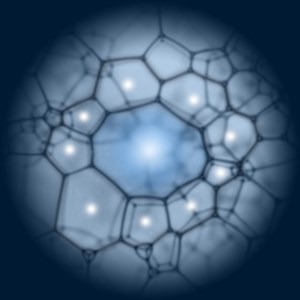
And while I likely won’t abandon the “orbital” mechanism for introspection, I do think I’ve a new metaphor for affinities — they’re a quite specific form of pocket or niche. There’s engineering behind why a honeycomb looks the way it does. Comparable principles dictate that any three bubbles that connect will form 120° angles between them. If oneself is a pocket of interest, one’s range of interest would include adjacent pockets.

In a honeycomb, this would result in just six interests – all of equal proportion even to the central or “self” pocket. A globe in a volume of identical globes will touch twelve others at a maximum.

The visual metaphor for one’s range of interest is probably pockets of air in a volume of bubbles. Foam. Not all of our interests have equal attention paid to them. They don’t all last for the same duration. The adjacency still applies; anything non-adjacent to the “self” bubble is out of range. In a volume of foam, whichever bubble represents the self (and self-interest) is surrounded not only on one plane but above and/or below as well.

Bubble theory

Funny story… Guess what the universe looks like at the grandest scale presently possible.

foam

It’s a bit of a foam. I’m not saying anything. I’m thinking a lot, though.

The other handy think “bubble affinity theory” provides is the idea that if bubbles could overlap instead of mutually building walls they would form lenses. Almost a year ago I was struck by the notion that we see each other through a lens defined by our respective sense of self.

We should expect this to evolve as well.


sententiae antiquae…

An admission of a bias in thinking due to the near-total immersion in Ancient Greek mythology and philosophy must be made. There is the concept of (Abraham) Maslow’s hammer, “I suppose it is tempting, if the only tool you have is a hammer, to treat everything as if it were a nail.”

Recently, the question arose in two parts of whether writers in this modern zeitgeist are consciously using elements of the philosophy of Plato (et alia) in their works of fiction. Parallels seem strongly evident; are they always intentional? Are the tropes of ancient thought strong and pervasive enough that even those who are not aware of their origins – or seeking them out – are almost destined to use them?

George Lucas is known to have based Star Wars on his study of Joseph Campbell’s work, which was in turn a summary of many others, Plato included. Similarly, Lana and Andy Wachowski may have based their Matrix (at least, in part) on Plato’s Allegory of the Cave.

IDEA

The reimagining of Battlestar Galactica (2003-2012) probably could not avoid using Greek myth as source material with many of the characters named after the Olympians. BSG also paralleled Ecclesiastes 1:9 and Peter Pan when Six and President Laura Roslin (among several others) presented variations of “All of this has happened before, and it all will happen again.” The verse in the Bible goes on to postulate “…and there is no new thing under the Sun.” – an idea about which I’ve previously railed.

The past week’s musing has given me a series of ideas that may cause me to adjust my perspective for A Song Heard in the Future, my novel-in-progress set 3.5 millennia ago.

Some scholars of myth believe that Teiresias was a well-known character before he was written into the tragedies of nearly all kings of Thebes, including the trilogy of Oedipus’ life. Of the dozen or so tales that include Teiresias and still exist only a small percentage of them could be said to feature him as the main character.

Hesiod is said to have written about the famous seer almost 2700 years ago but that story has been lost. At roughly the same time Homer also included Teiresias but as a shade in the Asphodel Meadows neighborhood of Hades. The intent in Song is giving Teiresias back the lost story of his life.

If an author’s themes are preordained, if there truly is nothing new, the task at hand is to make the best of it. To craft the best from it. If Song is reimagined based on last week, there’s a very good chance the book will be better. Oddly, it will also take a few steps closer to the reason for researching Teiresias in the first place. Psychic abilities have always fascinated me whether they exist or not. (And I blame Spock for it.)

A leap to someone in Ancient Greece who could see the future seems obvious but the road was not quite that direct. During my middle school years, I sometimes would construct fantasy timelines of reincarnations I might have had. My birthday was in mid-December of 1964; who died earlier that year that I might have been? And who just prior to their date of death? And so on… This fabrication of an uninterrupted line of past lives would extend as far as my knowledge of history would permit.

Something very like this led to Teiresias but I allowed the tracking and musing to move into legend and then myth, as records grew less authoritative. To my mind, the jury is still out on the details of reincarnation. I’m not sure we can be certain who we may once have been. Here the innumerable ex-Cleopatras have to be discounted.

In psychical research there is a term “anomalous cognition” that is meant to describe having knowledge without learning it. The best example of this may be the understanding some aspect of a dream without the establishing that would be required if the same plot were presented in fiction. Psychic studies go beyond that point but it means knowledge without a source or explanation. There had to be a word for the idea that we can retain knowledge from past lives, if any.

In the field of psychology (if I have this right), anomalous cognition is used to describe specific exaggerated reactions. As both science and paranormal research employ AC and with neither usage hitting the nail on the head, there had to be a more precise word. With all due respect to reverse dictionaries, they nearly always far short. Finding a new word is simple. Read more. Talk to smart people. Finding an extant but unknown word that precisely fits a specific concept is not so easy.

Just yesterday, while exploring Plato’s ideas, I discovered the word anamnesis. This is precisely what I find fascinating in anomalous cognition while not preferring the term. What you knew in a past life is something your education may serve to remind you of that past knowledge.

Plato suggested that we are reincarnated based on what we know. Ultimately, aisa (“αἶσα” meaning “destiny”) doesn’t matter in our thinking and work. It is how we think and work that remains our own.

Maybe there is nothing new under the Sun. When Song is published, however, I’ll invite you to curl up against a tree and read it in sunlight. If it surprises you – that may disprove predestination. If not, welcome back.


Oh, the places he’d been…

Today is the birthday of a man known as Dr. Theophrastus Seuss. I’ve more of an affinity for his work than I think I’ve reason to do so. It isn’t just Horton Hears a Who! or the one about all those fish that I remember fondly; the particular favorite is On Beyond Zebra!

Criminal Element has published a new essay of mine, in which I cover some of the less well-known details of Mr. Geisel’s life and career. In preparing for the article I discovered some details I’d either forgotten or never knew at all.

Now I want to see a biographical film. In the meantime, please consider reading the post with CE.

Hi-Code


ناظم


Meanwhile, Fortius…

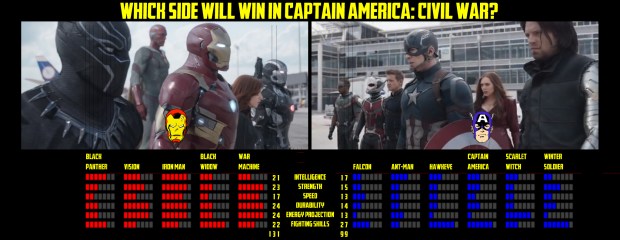
Civil War.jpg

By the numbers, with five on Team Red and six on Team Blue, one might be tempted to predict Captain America’s side [Blue] will win. That said, evaluating each individual character and collectively by the sides chosen shows more actual superpowers in Iron Man’s faction [Red].

Marvel sometimes rates its characters in six categories of a Power Grid:

  • Intelligence
  • Stength
  • Speed
  • Durability
  • Energy Projection
  • Fighting Skills

These are measured on scales from 1 to 7, with 2 considered the score for the normal person – regardless of category. Red is more powerful in all but the last rating. Tony Stark’s stance in Civil War and those who support it are – in total – almost a third again better than the First Avenger and his troops. Advantage: Red Team!

Given the leadership and tactical advantages Steve Rogers can be presumed to possess, his side will almost certainly have the better strategy (without actually determining a way to avoid a physical conflict). Advantage: Blue Team!

The most powerful single heroes in the fight are Vision for Red and Scarlet Witch for Blue. The synthezoid delivered the coup de grâce against Ultron via the Mind Gem and therefore, if used against any member of the opposing side, would be more than sufficient. As the mutant’s powers have been portrayed in the Marvel Cinematic Universe (MCU), the only member of Stark’s faction that might be immune is Vision.

The respective powers of these two both count as Energy Projection and they are  equivalent according to the Power Grid in that aspect. Logically, the fight should boil down to just them and, with regard to every other rating, Vision is superior. Victory: Red Team!

But…

Joss Whedon is well-known as a geek. This includes playing Dungeons & Dragons – so we can guess that he’s experienced in overcoming the numbers on any character sheet to triumph. He’s also not stranger to chance influencing the outcome; he’s probably rolled his fair share of Natural 20s. Maybe losing side before the third act will get unexpected help from Spider-man in some way (making him the Random Encounter).

In addition, although I’ve never played D&D with Mr. Whedon, he will twist the rules as much as serves the story – and maybe a little more. Even taking that into consideration, there are a few things I doubt he’ll avoid.

Expect to see most of the following…

  • The MCU’s two newest, Ant-Man and Black Panther, will make trouble for each other – demonstrating what they’re capable of in a “fresh” way.
  • The two women will engage is some manner of one-on-one conflict and it will probably be more or less a draw. The audience probably expects this but it’s been done to death.
  • Some moment of brotherhood between two of the three characters of African descent is likely and, if handled well, could enhance the story.
  • Hawkeye will last longer than he should given the odds and any form of sense.
  • There will be a nod to Scarlet Witch and Vision potentially having a relationship at some future point, if the film parallels the comics that is.

Mr. Whedon has written many actual comic books, including the first 24 issues of Astonishing X-Men. (It’s ironic he can’t use those characters in the film.) We know from his body of work that he features and favors the underdog. Buffy, its extended franchise, and Firefly/Serenity (i.e., almost his entire oeuvre) all demonstrate that he’ll kill a beloved character.

These factors in conjunction mean the underdog pack will almost certainly win but it will cost them at least one of their (our) favorites. Prediction 1: In Captain America: Civil War, Blue will win the day but the titular character will “die” just as he did in the comic book arc on which the film is based.

“Tahiti is a magical place.”

Since Agent Coulson’s death and return, that is a new euphemism for the comic book death trope. Prediction 2: The post-credits stinger(s) will show all of this is playing into the hands of Thanos and then remind us of Valhalla while hinting at Cap’s return from it.

Only uncle Ben is staying dead but that’s another franchise.


Citius, Altius, and away…

When I was very young my great grandmother told me, “If you want to be something – first admire it.”

In some way, shape, or form that statement of simple truth has stuck with me ever since. It informs who I hope to be as a person and is part of how I construct characters. To a certain extent, it is part of my reaction to other people and to the work of other authors. All of these situations raise the question: “What is being held up to be admired here?” It is rarely far from top-of-mind.

This may also be why I have never quite been able to count athletes and rock stars as true heroes. Their accomplishments can certainly be admired but it seems likely that any record can be surpassed with diligence, proper training, and a bit of luck.

If being admirable is at least part of the definition of a hero, doesn’t that begin with their code of behavior or conduct? A set of binding principles that contribute positively to the quality of the individual in question seems a better yardstick than the applause of a stadium of fans. Being admirable on the basis of such faculties is an essential part of true heroism. They don’t have to be perfect. In real life that’s impossible and in a novel it damages the story.

The heroism of Superman is characterized by his “never ending battle for truth, justice, and the American way.” Officer Alex Murphy, better known as RoboCop, initially operates with three explicit directives: 1) Serve the public trust, 2) Protect the innocent, and 3) Uphold the law. The number of traits need not be limited to three. A short list does, however, make any potential hero more comprehensible and accessible.

In addition to The Code, a would-be hero must choose to do good. Many heroes make this choice regardless of whether anyone will ever know. They are not motivated by a reward. The achievements of a hero must also be above and beyond the simple good society encourages from all of us. The average good is not heroic; it’s expected after all. A hero must exceed the achievement of good that the average person might accomplish regardless of determination, acquired expertise, or good fortune.

Heroes – in life and fiction both – should inspire us whether we can replicate their feats or not. We should honor them when they help us toward being the best human we can possibly be and then reset the scale to try for more. Heroism is an ideal. It should perpetually be out of reach and eternally pursued.

Our heroes are the embodiment of our aspirations and hopes, our desire to believe that we are capable of facing anything and against all odds. We dream of ourselves as willing to act in defense of our ideals no matter the cost.

In the film Iron Giant (1999), a young boy by the name of Hogarth Hughes tells the robot, “You are who you choose to be.”

superman

I think that strongly echoes my great grandmother’s advice.

In Elizabeth (1998), Sir Francis Walsingham tells his Queen, “All men need something greater than themselves to look up to and worship. They must be able to touch the divine here on earth.”

This is, in essence, the point but not necessarily from above or outside – but from what is worthy of our admiration and awe.

Doing good is not enough.

STADR


Graecum est; non legitur

Letters are fascinating. Why shouldn’t we find them so? Their shapes afford us a sense of order if not actual orthodoxy and by them – along with the sounds they represent – we attempt to make ourselves known. Letters are even how we identify ourselves.

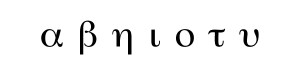
As writing systems are essential to our having a recorded history, letters are as old as time. In his last fable, Hyginus states, “The Parcae – Clotho, Lachesis, and Atropos invented seven Greek letters.”

ΑΒΗΙΟΤΥ

The novel I’ve set in mythological Greece won’t be written in Ancient or Modern Greek but I have been making an effort to get the character names and certain terms correct. Effort at being thorough and accurate has often taken me to the area where fascinating letters become tricky things — in combination they invite pronunciation, spelling, and meaning.

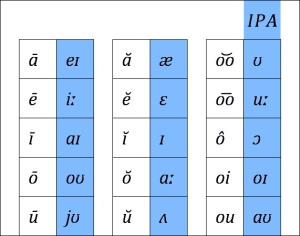
During my formal education the pronunciation key in any dictionary made use of diacritical marks. Later the International Phonetic Alphabet (IPA) became the key of choice. Though there is an online English-to-IPA translator, I’ve yet to find one that works in reverse. I still have to compare IPA vowels to a diacritical chart.

dia v ipa

In addition to the story of Teiresias, another novel in development takes place chiefly in WWII-era Great Britain. This setting brings up an entirely new set of permutations of expression and a few slightly different vowels.

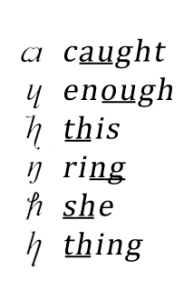
While on his third visit to England and attempting, among other things, to have Pennsylvania made a Royal Colony rather than a proprietary province, Benjamin Franklin devised A Scheme for a new Alphabet and a Reformed Mode of Spelling.

The premise of any phonetic structure – beyond illustrating pronunciation – is that knowing how a word sounds is the same as knowing how to spell it. Dr. Franklin removed c, j, q, w, x, and y. Six new letters were introduced. The rules are not included here but many websites provide them.

Franklin letters

It seems unlikely that Franklin’s scheme could have replaced the alphabet; it would have meant having to relearn to read and write for those who already knew. Dr. Franklin did give permission to another to try.

“As an independent nation, our honor requires us to have a system of our own, in language as well as government. Great Britain, whose children we are, and whose language we speak, should no longer be our standard…” — Noah Webster

Both men became more involved with The American War of Independence. Spelling and use of certain words were deliberately – and apparently irrevocably – changed. The British-import alphabet thankfully remained.

When not writing or involved with other arts and history, I sometimes explore the world of conlanging – a documentary about which was directed by a friend of mine – Britton Watkins. Conlanging is the pursuit of developing new languages and/or alphabets, usually for the sake of fiction.

Examples include languages of Tolkien’s elves and of Roddenberry’s aliens (developers include Dorothy Jones Heydt, Mark R. Gardner, and Marc Okrand). Mr. Watkins has also produced a very thorough and beautiful font for writing in Vulcan. The best-known real world conlang may be Esperanto, created by L. L. Zamenhof and offered with high hopes as “an easy-to-learn, politically neutral language”.

I hesitate to say that most conlangers use the IPA while developing their new languages but many do. This is particularly true of most of the dozen or so who’ve attempted a Circular Gallifreyan font. Exceptions include the systems by Loren Sherman and Rachel Sutherland, respectively. Their alphabets are the most commonly used by fandom.

Hexagon

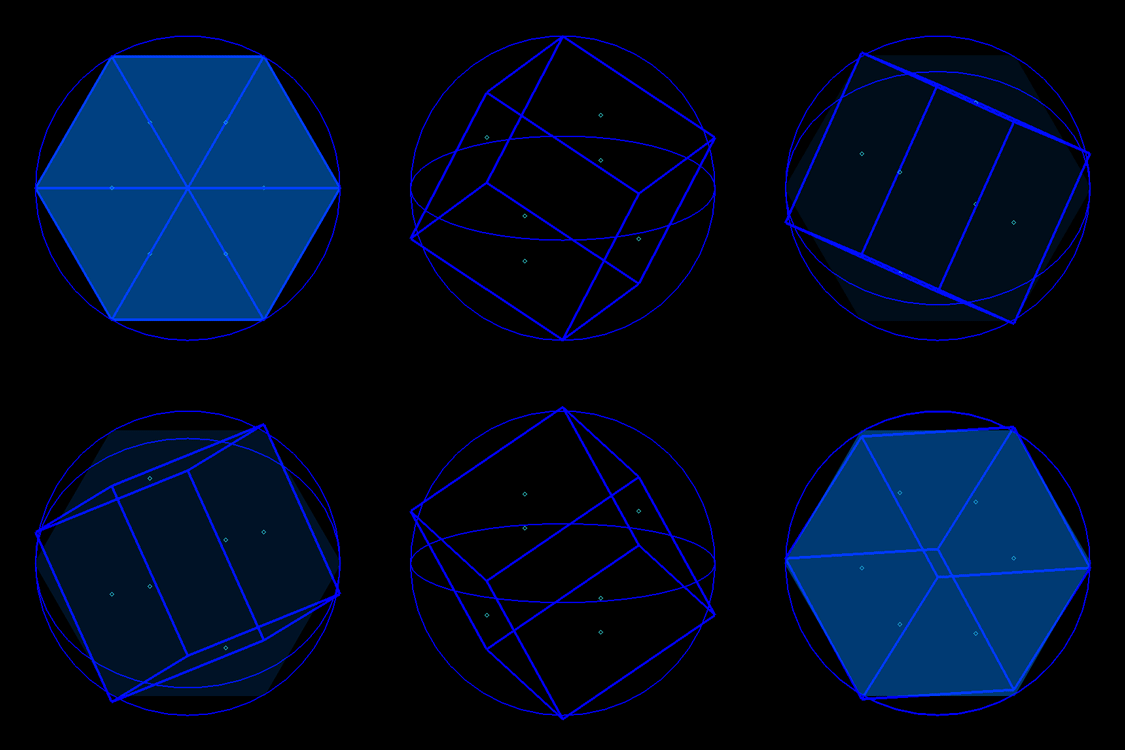
All this to say — we may not have been looking at the symbols of the Time Lords from quite the right vantage point. Every letter – real or imaginary – is two-dimensional. Given time and relative dimensions in space, Gallifreyan letters may not be flat shapes; I don’t think it’s Circular at all. For the sake of art and of curiosity, I am developing a new system and will likely produce a font and/or Photoshop Brush Set. The guide will include IPA and diacritical alike.

revolve


鬼劃符