Beyond the conventional…

Note: You have my apologies for missing a few posts. I had intended to post my Dragon Con schedule of panels and some other important information about that event prior to it. It turns out the world wide web is more of a guideline than a rule. In addition, this being my second Dragon Con, I am still getting my sea legs with regard to the frenetic pace.

Both of the panels on which I was a presenter took place on Sunday (Sept. 6) as part of the Alternate History Track ably run by Enrique Velazquez (a.k.a. “Dr. Q”). The first topic was under the description, Dieselpunk and Raygun Gothic in the Media and we discussed the cousins of steampunk. There have been many attempts to define the line between steam- and dieselpunk but during the panel we linked it to what I feel are two important distinctions:

• Whether the airship is lighter or heavier than air. This is broadly a question of all technological differences between the two sub-genres – airship or not.
• The societal changes of the Roaring Twenties and the Great Depression. The summary of the Interwar period between WWI and WWII is too vague and simple. Dieselpunk is grimier than Steampunk. The loss of affluence and of innocence, along with a drastic change in social order deserves more attention in the differentiation in history and in fiction.

My second panel was called, Vintage Advice and Accessories for the Modern Gentleman and it began with a discussion of etiquette – as it, if fact, should have. Each member of the panel has a bit of a reputation for being sartorially savvy (including myself, if I may say so modestly). Being known for proper comportment is something to which we should always aspire and diligently work to improve.

The host of the panel, asked us to name an aspect of behavior we would like to see return to daily civil interaction and another that we did not see as having much chance at restoration.

costumesI mentioned that Dragon Con can be hectic. There’s too much to see. Leanna Renee Hieber and Alethea Kontis provided veteran advice and both were far busier than I.

Ms. Hieber was on four times as many panels as I, three of which I was glad to attend. With her impressive career in publishing and her scholarship of Victoriana and the paranormal, she was able to provide a fine through line of the fantastic and magical – leading to Derek Tatum‘s introduction of dreadpunk as a newly defined subgenre.

And for the second year in a row Princess Alethea’s Traveling Sideshow entertained me (and many others). This feature of the Dragon Con YA track has been going on for far longer and based on two shows, I recommend it to all ages.

A fine discussion of creativity involving Ted Naifeh, a talented artist I’ve known for many years. There will be more on that in future posts.

Then came a visit with Randy Reitz and Cathy Cox – my second this year. They both provided some valuable insight on some upcoming projects, some of which readers of this blog know about and another about which I’ll be able to share details next month.

It was then time for Space Coast Comic Cons inaugural. I’ve been to many first-year conventions and this one did so many things right. I was happily recruited by Mark Who 42 as a panelist for two Doctor Who-related hours.

All of this was enjoyable and a learning experience. Now back to art and writing.

vortex

“Let me sum up.”

An annoyingly catchy tune from 1992, Dizz Knee Land by Dada, has been on my mind for the past few days – but with “Dragon Con” substituted for “Disneyland”.

thom at dragon conNote: I apologize if that song is now playing on repeat in your head.

This will be my second year attending Dragon Con. I will be posting a schedule of the panels on which I’ll be presenting as the date grows a bit closer.

This event is, as you might suppose, always very exciting. It has been a busy year for me since my first time there. I’m in progress on two novels, which readers of this blog are aware. Together with my coauthor and business partner, Leanna Renee Hieber, we have introduced the adorable “feels assistants” – a.k.a. Pandora’s Pets to more than 100 customers and a growing number of stores. I was quite honored to develop the four separate covers for Ms. Hieber’s upcoming release of the Dark Next Chronicles.

DNCWe have both written separately for an illustrated anthology of Lovecraftsmanship that’s expected to launch in October – probably just in time for Halloween. Along with the other two members of PsychWing (i.e., The Nerdy Duo) we are developing a short science fiction film.

combo logo

It has been a year (plus) of dreams coming true.

Note: Until after Dragon Con there may be a slight disruption in my once-a-week posting to Surfing the Zeitgeist.

Reinventing a few specific wheels…

In the early ‘90’s, I accidentally reinvented Robert Plutchik’s “Wheel of Emotions”.

715px-Plutchik-wheel.svgAt the time I was employed as a Human Resources manager. I had taken the position in what turned out to be the wholly wrong assumption that the existence of HR departments within corporations was an admission by companies that they are soulless entities and that some sort of concession had to be made. Presumably, employees have souls even in the soul-crushing environment of the cube farm.

Logic dictated that any visit not involving interviews of those seeking employment would be by someone already with the company who was some shade of mad or sad. Whether we should wish to be glad at all times we do have that wish. So, I knew where visitors to my office wanted to “go” but their exact “point of origin” was too broad and vague. I do not believe that I am unique in not liking to be surprised by people. Wanting to help others as quickly as possible may be somewhat more rare.

I needed to craft a tool that would help me help the employees who came to see me. It was, I suspected, akin to a navigational problem. Beyond that, there were two ingredients to my Emotion Map, the color wheel and a quote from Spider Robinson.

Mad, sad, glad; what else is there?”

Mad is traditionally matched to Red. Similarly, Sad is associated with Blue. That left the healthy hue of Green for Glad. Other emotions were set on the color wheel by making some estimations of triangulation.

What’s twice as far from Glad as it is from Sad? What’s the midpoint between Hope and Gratitude?

I don’t have a background in psychology and, as you might guess from any of my previous posts about Vulcans, approached emotion from an almost scientific stance. I was possibly detached. Emotion was not my field.

It shouldn’t be surprising that my map and Plutchik’s Wheel disagree in terms of placement of specific emotions. But there’s another significant difference. My map places extremes of feeling, such as rage and bliss, on the perimeter of the circle. This is the opposite of Plutchik’s illustration. In the center of his model the colors are bright, fading toward the outside. My map fades to pure white in the center.

I felt that the more confusing, mixed emotions should be in that white space. It’s difficult to tell frustration from apathy. The center of my map was part of the tool; it was the doldrums around which I hoped to help, in my HR capacity, each visitor avoid on their course back to Glad.

color wheelNote: I’ve left labels off a new map as I’m revising it gradually.

Although I don’t still have the original copy of the Emotion Map, and I’m no longer working in HR, I do still use this theory. More recently — within just the past year or so — I’ve begun to revisit it. I’m less detached. I’m feeling more. I am now cultivating the field of my own emotion rather than merely surveying that of others.

And I think that’s making me more effective creatively. Art and writing without emotion cannot hope make an impact, can it?

It’s poetry in motion…

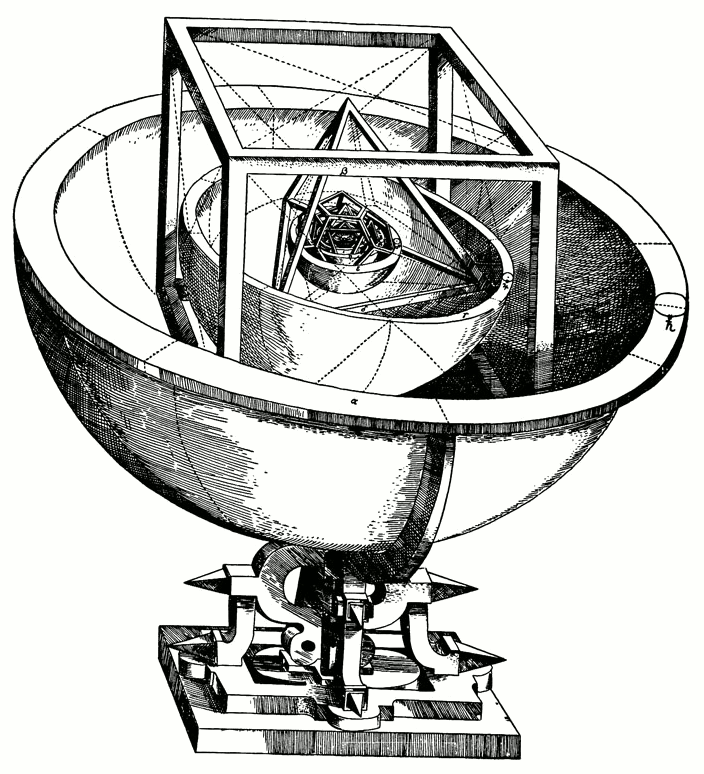
We are – for lack of a better word – programmed to look for meaning. Our education works to enhance this natural tendency. It may be why some have an affinity for sacred geometry. Certainly Johannes Kepler attempted to demonstrate that meaning was a built-in feature the solar system (Mysterium Cosmographicum, 1596).

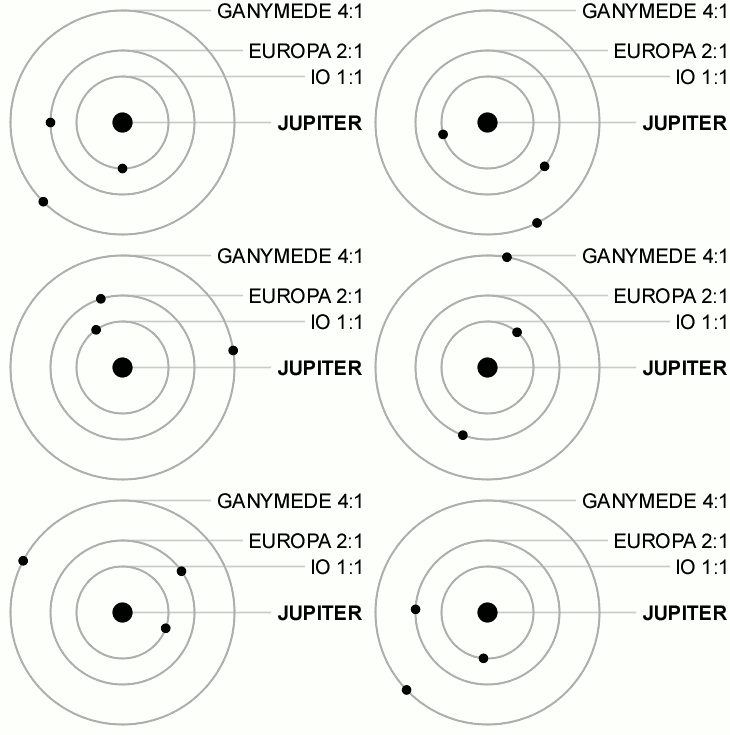
Kepler-solar-system-1The phenomenon of one or two orbits helping to predict the next may not be by design but gravity does create some poems in the cosmos. Resonances – such as that between Jupiter’s moons of Io, Ganymede and Europa – are my favorite example. For each of Io’s orbits, Europa makes two and Ganymede makes four.

Galilean_moon_Laplace_resonance_animation_2But science is not the only field of study.

Imagine there were some mental equivalent of gravity and celestial bodies. Suppose that this explains why certain ideas – presumed forgotten – return to us from time to time. Or that it is precisely why certain locations are thought to be frequented by ghosts. Wouldn’t that be cool?

For quite a long while I have enjoyed this poetry and I can see why it has an appeal, particularly in astrology. It would be very nice to know why the wheels seem to fall off the wagon when Mercury is in retrograde (which it isn’t) or why it’s a good idea to be more mindful when Uranus is in retrograde (and it is). And though these changes are not caused by planetary action, the poetry serves as a reminder that they do, however, happen.

Notwithstanding ☿ and ⛢, et al. – or haunting thoughts or spirits – the cosmos is a very big and usually unpredictable place. Maybe it’s unfair to consider astrology a pseudoscience.

Certain aspects are really just a To Do List.

ceteris paribus…

It is probably reasonable to assume that the faith of our parents, if any, is assumed in our early years to be the only faith. I remember noticing and asking about the different iconologia and emblemata of the 14 houses of worship in my very small hometown. It was a disproportionately large number of options. For reasons that are beyond the scope of this post, I was a member of at least five different congregations belonging to different Christian denominations before the age of 12.

And prior to that age, the United States was ramping up to its Bicentennial celebrations and participating in the first two Olympics of which I was aware (some years before the Winter and Summer Games were split and staggered). On display at home was a vast array of old and newly minted patriotic symbols. Each nation of the more than 90 competing The Games (half the world at the time) had brought an entirely different selection of icons to the stadium.

Surely formal education contributed to an awareness of how much larger the world is than I might have imagined before adolescence. But the diversity of religious and national expression was given sharp emphasis by experience and observation. This has allowed me to acknowledge that dignity can arise everywhere on the planet – from each person who will allow it to manifest – regardless of place of birth.

There is a vogue in political thought here, the notion of American exceptionalism. The nation may unfortunately have been born with it. The soil here is not a magical home plate (to employ the metaphor from our “national pastime”). It isn’t where a person is born or lives that makes their accomplishments special. Accomplishment and the person who achieves it are both special – anywhere. I’m not running for office. I don’t have to perpetuate a myth.

As readers of this blog may have guessed, flags and maps fascinate me. A flag is not just the equivalent of a postal code. It is a declaration of a certain set of beliefs and, it must be said, opinions. A map is more than a tool for where to find things. For me, maps have long and collectively been metaphors for the intrinsic potential of what things may be found.

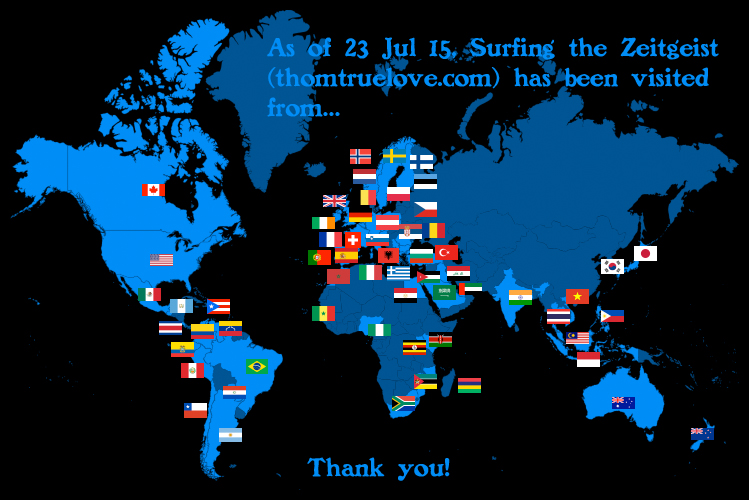
thank youSurfing the Zeitgeist is intended to share my perspective on the value and mission of creative expression – along with a certain view on the universality of potential. The above map shows the nations from which Visits have been made. I track this as a reminder that there isn’t just one zeitgeist to surf. Each visit is more than a “pin in a map” for me. It’s a vantage point – a reminder that my point of view is only one way of examining the zeitgeist. I’m curious about them all – and I think I always have been.

Bubbling up…

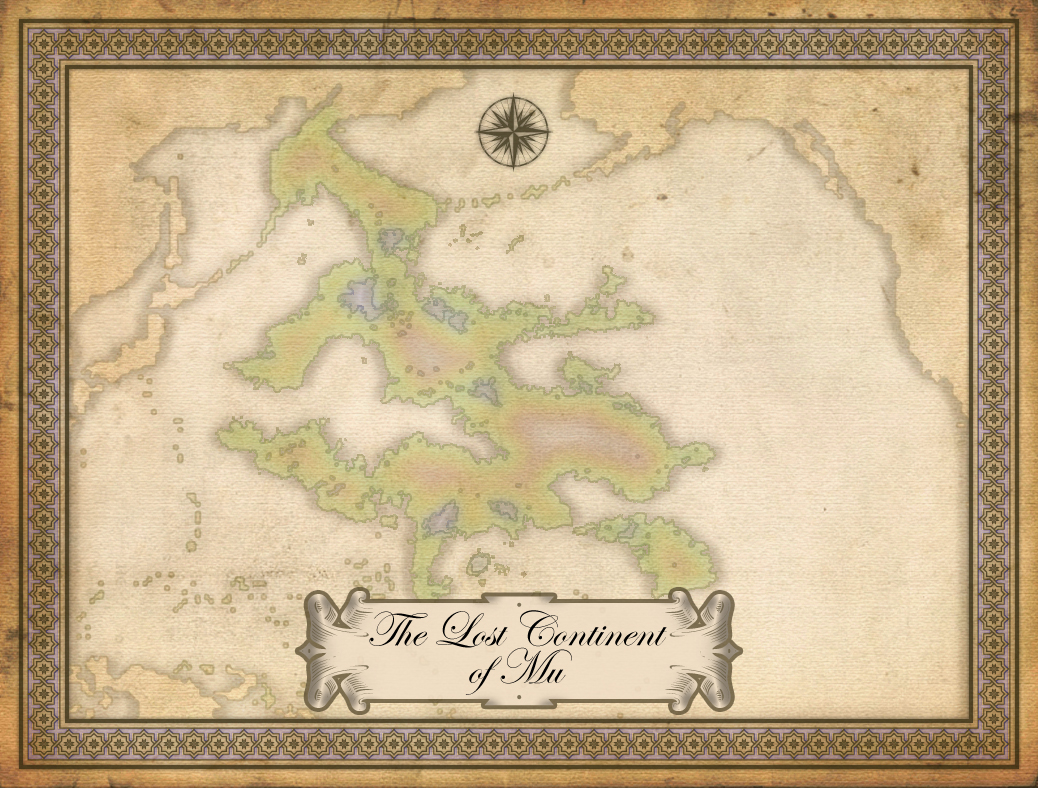
Talented coauthor and dear friend – Leanna Renee Hieber – shared with me an opportunity to contribute for an upcoming anthology. She and I are among those asked to blur the line between fact and fiction in each of our separate pieces. During the writing I was able to refer to a pair of maps I’d made over ten years ago. At that time I was playing an online game that was a little light on details. Maps of Lemuria and Mu were made to assist other players in visualizing the play environment. And since they took a rather long time to create, I saved the files. I’m truly glad I did. LemuriaThe artistic approach for the fabled sunken continent of Lemuria began with a bathymetric map of the Indian Ocean and the coastlines provided by theory. In the case of Mu, there is not a precise border so the coast used a similar process to build out that of real, existing islands. mu mapIn the online game mentioned above, these maps were to record fictional claims on imaginary lands. They were used while I wrote to keep certain details straight. Sunken continents have always fascinated me – at least since 2nd grade. It seems odd that we’re taught the myth of Atlantis before the dynamics of continental drift. Details about the anthology can’t be provided here but updates will be when available and appropriate. I’m curious how each contributed piece (mine and that from Ms. Hieber included) might work together as a whole. When it is released, I believe I’ll be reading it with the same sense of wonder I hope other readers will.

per mutatio…

In art nouveau, and particularly the work of Alphonse Mucha, we frequently see an arc of ever-smaller circles around both sides of a round frame. Mr. Mucha found this structure fascinating and, I must admit, I do as well. I won’t go as far as to suggest it counts as part of sacred geometry (either for myself of for Mr. Mucha). But it is very appealing to my aesthetic.

In mathematics, such a figure is called either a Pappus chain or Steiner chain – depending on specific tangency. I’m certain it has a name in art world but I haven’t rediscovered the term (yet).

As you may have seen in previous posts to this blog, I am creating sculpture and art in addition to written fiction. The Star Trek-inspired novel¹ on which I am in progress has introduced a sister muse. The television series and motion pictures showed us very little Vulcan art. Much as I might prefer otherwise, I do understand that Vulcan culture is not the main point of Star Trek. But it is the emphasis you’ll find on The Taan Shop².

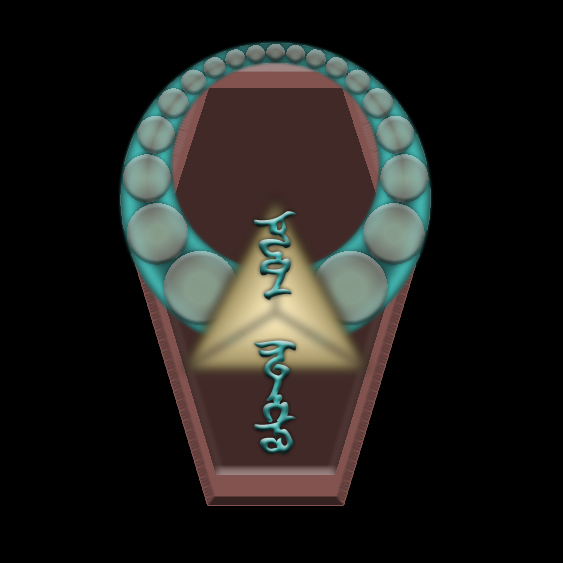
ta'an 2Just this week I was able to blend two examples of Vulcan art and symbolism (the IDIC and the coffin-shaped chime/gong) with the Mucha crescent. The words shown are kau and yehtwise and true, respectively.

Pandora’s Pets are creatures of expressed emotion. The items presented on The Taan Shop could count as the opposite. Or maybe not. Fans of Star Trek know that Vulcans embrace logic. We know from the salute of “Live long and prosper” and the philosophy of “Infinite diversity in infinite combination” that their perspective is more nuanced than commonly thought. It seems more likely that the Pets and the ta’an are two sides of the same flag.

Both projects are evolving and I feel they should. You are invited to pay a visit.

Vulcan Tarot frame


¹ “All We Now Hold True
² More accurately, the Vulcan word for gift would be transliterated as ta’an but that would confuse the URL.


Note: The Vulcan font was designed and provided in beta form by Britton Watkins. He is the developer and director of conlanging, a documentary on the art of making fictional languages and writing systems.

all together now…

handshakeThe desire for diversity to be respected is understandable and vital. Identity is not defined by region, race, or religion alone. We are, each of us, defined by our thoughts and our experience. This need not isolate us but it does mean we are each the ultimate minority – a minority-of-one.

“No man is an island entire of itself;…”
John Donne, Devotions upon Emergent Occasions, Meditation XVII (1623)

We require society and we all contribute to it as a state. Until 1956, the unofficial motto of the United States was E pluribus unum (meaning Out of many, one). Diversity was, at least tacitly, understood as a strength for 174 years. In the same breath, so was Unity. We’re having trouble with both these days. It wouldn’t be scientific to claim that the change of motto was the sole cause but it might mark the beginning of a decline that’s lasted 59 years and counting.

The sociopolitical climate of the United States has become too fertile a soil for the notion that liberty means absolute freedom from having to follow the dictates of any authority. A very recent example involves a Texas man who literally jumped to fatal encounter with an alligator. He is reported to have said, “[Expletive deleted] that alligator.” after seeing a sign that warned against swimming in Adams Bayou. It seems very likely that he was metaphorically saying, “[Expletive deleted] the Man.”

Signs like the one he ignored exist for a reason. But they’ve all become metaphors for why Liberty does not mean do anything you want, anywhere, at any time.

“Liberty means responsibility. That is why most men dread it.”
George Bernard Shaw, Man and Superman (1903)

Liberty is a much more complicated concept than seems commonly supposed. It is meant as a process by which we establish and maintain freedom of the individual from interference or coercion. Intrinsic is a duty of respecting the equal rights of others and just laws expressive of just powers designed to safeguard the equal rights of all individuals. The mechanism of this specific freedom includes self-respect as a spiritual virtue, self-reliance as an economic virtue, and self-discipline as a sociopolitical virtue.

On Sept. 24, 2013, at 8:04 (EST), Senator Ted Cruz (R-TX) read Dr. SeussGreen Eggs and Ham during a filibuster on the Senate floor. It would have been more constructive had he chosen to read both Chicken Little and the Little Red Hen; the sky may indeed be falling and we all have to pull together.

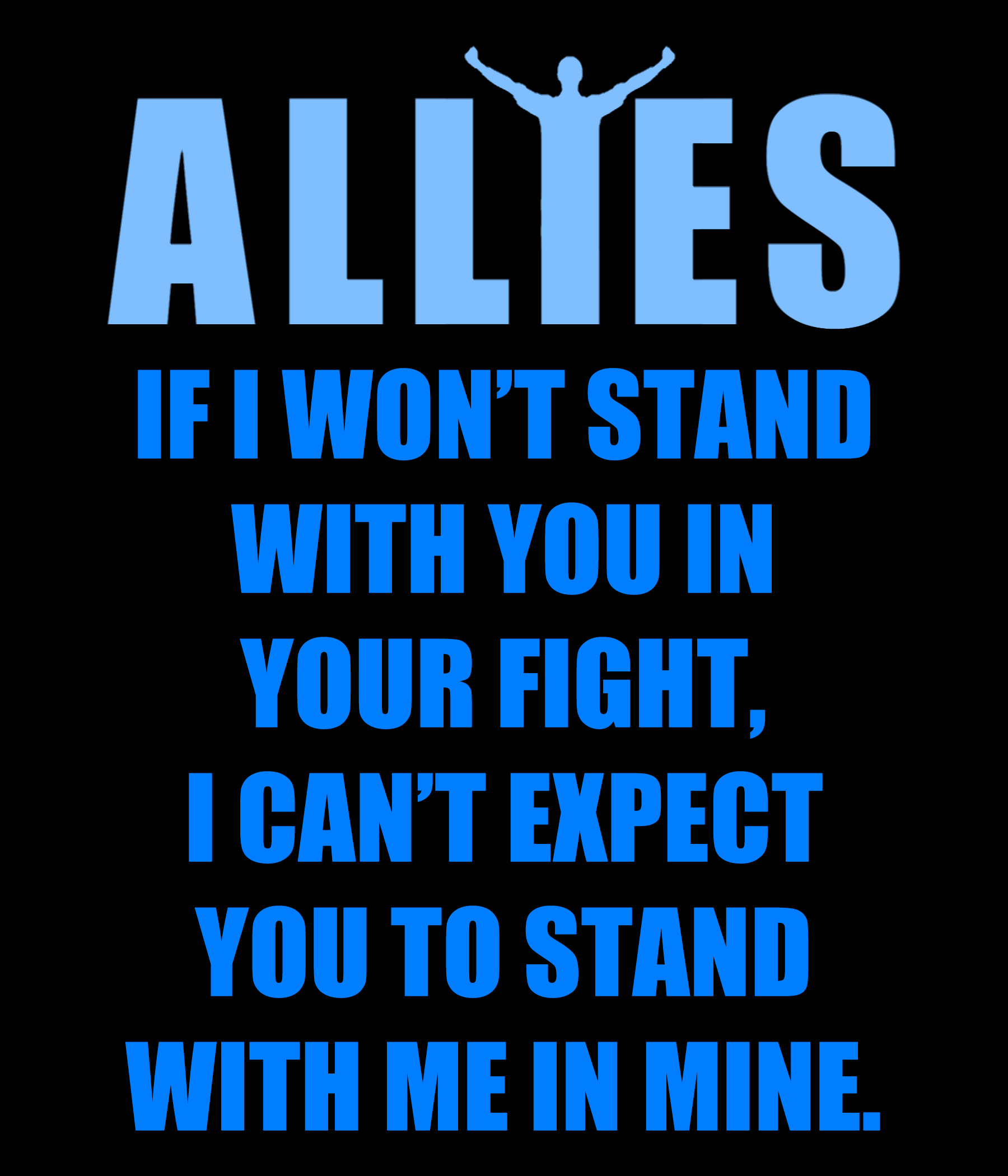
I am a minority. I am a Self. The same is true of you. A community is a union of interdependent Selves who work best as a whole when each is possessed of self-respect (the spring of respect for others), self-reliance (the well of an economy that benefits all), and self-discipline (the fount and foundation of most other civic and civil worth).

alliesOr, to use a more famous quote…

YKNOW

kau tipping…

For more than 100 years discussion of fiction has been improperly saddled with the term canon. When considering what’s thought canon is primarily a mechanism to preserve the suspension of disbelief, the use of the term becomes almost ironic.

We owe this word’s improper use to the original Sherlock Holmes drooling fanboy, Ronald Knox, who wanted to draw as thick a line as possible between the oeuvre of Sir Arthur Conan Doyle  and other authors who subsequently undertook the Detective’s chronicle.

Canon both designates the authoritative elements and helps in establishing continuity. For writers it can serve as a tool (sometimes called a bible; also not exactly appropriate). For fans it is the timeline and the answer book for geek-cred quizzes. Keeping track of who’s who and what’s what is important for both but “continuity” should be a completely effective term for both author and audience.

The need to have the story straight is likely as old as storytelling. We may imagine arguments at pub between Knox and other followers of Holmes’ adventures but such conflicts are probably as old as storytelling.

If Pylaimenes was killed by Menelaos, how could he be there to see his son Harpalion die?”

As I research the novel concerning the life and times of the famous seer Teiresias (A Song Heard in the Future) – I discover quite a few problems with the body of Greek mythology. There are many chronologies and each is based on different assumptions and starting dates. The dramatis personæ don’t always align or include the all of the same people.

When it comes to the Star Trek book I’ve more recently begun writing (All We Now Hold True), the complications are actually greater. The number of voices in the oral tradition of Greek myth can never be known but the record comes from only a few. A listing of writers of Star Trek episodes, films, and novels now includes hundreds.

An Uncertain Enterprise
Even before the first episode of Enterprise the cry about the continuity minefield Rick Berman and Brannon Braga seemed to be rushing into went up from many fans, myself included. In the premiere of that series, we were shown they were going to play a bit fast and loose with “canon” as we knew it.

In the second season they began contradicting what I feel most fans of the Vulcans held true. For example, it had been presumed for nearly 40 years that each member of that (yes, fictional) race had the ability to mind meld. Forty episodes into Enterprise we were asked to accept not only that it was a rare talent but also those who engaged in it were subject to social stigma. There is no word for scoff in Vuhlkansu (the Vulcan language).

And Deeper into Darkness
But since 2009, who cares — right? The new director of Star Trek, J. J. Abrams, made no secret of the fact that he couldn’t get into the original shows. I think he meant they bored him. So nevermind Spock’s efforts at unification of Vulcans and Romulans. In fact, forget the planet Vulcan entirely when all is said and done. If those in charge reject canon, aren’t we free to?

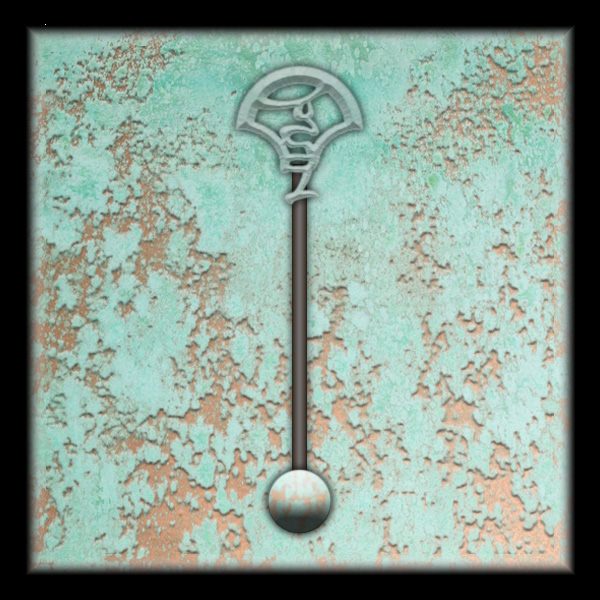
kau-lirpaThe above image is my take on a lirpa, an ancient and traditional Vulcan weapon. It does not precisely replicate those seen in the original series (TOS) or in Enterprise (ENT). That’s by design. The calligraphy built into the blade is the Vuhlkansu word kau – or wisdom. Since continuity is the issue and as “All We Now Hold True” is my effort to splice back the fractured Vulcan narrative let it be a symbolic scalpel rather than an axe.

I do intend to have True published in a capacity where it can stand its best chance of being considered “canon”. Will it be fanfic? All Star Trek should be written by fans of Star Trek.

Note: Due to working to place Pandora’s Pets in more brick-and-mortar locations, this week’s post was delayed. Thank you for your patience.

Takin’ it back…

Having been a member of the Boy Scouts, the presumption that all badges and patches were meant in celebration of both enjoyable experiences and the accumulation of experience could be a forgivable error.

When I first learned about the Star of David badges that the Jews in WWII Germany wore, my preliminary surmise was that they must have been voluntary symbols of resistance and pride. My mother responded in horror at the idea. She was neither an historian nor particularly skilled teacher but I did learn the truth about the Nazi intent. They were meant as marks of shame and easy identification of “undesirables.”

It wasn’t until high school, however, that I learned of one more such mark. By the end of the 1970s, gay rights advocates adopted the pink triangle – as reclamation, as an emblem. At that time, I suspect I should have suspected there were more triangular signs.

That prompt – to know the full list – came when I joined the Freemasons. In that case, as with all non-Jewish political nonconformists, the Masons detected and captured by the Nazis were forced to wear a red triangle.

In the United States these days, we hear all parts of the political spectrum engaging in hyperbolic assertions that one party or another is bordering near fascism. While we must always be vigilant to oppose the rise of another Nazi party, the ubiquity of accusation makes it difficult to see the lines that must not be crossed.

repeatDuring the time of the original Nazi Party, a declaration of loyalty was required. Not making such a pledge “earned” a triangle at least. If the same system were used today, the image at the left might be on my sleeve and pant leg.

It would indicate a Mason who continued to meet after a presumed warning, internment, and intent to escape.

The E stands for Erziehungshäftlinge, which designated intellectuals and suspected organizers of resistance.

In addition, everything seems to be dubbed “the civil rights issue of our time”, including – most recently – the impact of climate change. More hyperbole. More blur.

Meanwhile, there is a group quietly making use of this information. I am not affiliated and only discovered the white triangle while trying to find an image of liberty that was not a photograph of the statue stood on Ft. Wood, Bedloes Island (i.e., The Statue of Liberty).

Liberty Symbol describes itself as an association with the goal of support, development, and promotion of individual and collective liberties. This effort has adopted a white triangle as a symbol for those who see themselves as promoters of said liberties. The symbol serves a dual purpose – also being an emblem for those who have had their liberty curtailed unnecessarily.

Too quietly, Liberty Symbol offers the symbol as a public domain icon and encourages its use. The white triangle was chosen in another reclamation of a sort. I’ve purchased a fair few and given two as gifts and tokens of kinship.

lsWhen placing an order for a white triangle pin, two are shipped. “Because if I am, one of my friends certainly is too.” The pair cost just $5.66 (US) or 5€. And if an order is placed, avoid a delay in shipping by sending an email to the maker noting your order: contact@libertysymbol.com

Note: Acheter is the French word for to buy.

Liberty Symbol’s fine print ends with the following:

All the earnings, if there are some, will be used to pursue the association object true publications and event organization. The association has no employee and will regularly publish its accounting book details.”