Citius, Altius, and away…

When I was very young my great grandmother told me, “If you want to be something – first admire it.”

In some way, shape, or form that statement of simple truth has stuck with me ever since. It informs who I hope to be as a person and is part of how I construct characters. To a certain extent, it is part of my reaction to other people and to the work of other authors. All of these situations raise the question: “What is being held up to be admired here?” It is rarely far from top-of-mind.

This may also be why I have never quite been able to count athletes and rock stars as true heroes. Their accomplishments can certainly be admired but it seems likely that any record can be surpassed with diligence, proper training, and a bit of luck.

If being admirable is at least part of the definition of a hero, doesn’t that begin with their code of behavior or conduct? A set of binding principles that contribute positively to the quality of the individual in question seems a better yardstick than the applause of a stadium of fans. Being admirable on the basis of such faculties is an essential part of true heroism. They don’t have to be perfect. In real life that’s impossible and in a novel it damages the story.

The heroism of Superman is characterized by his “never ending battle for truth, justice, and the American way.” Officer Alex Murphy, better known as RoboCop, initially operates with three explicit directives: 1) Serve the public trust, 2) Protect the innocent, and 3) Uphold the law. The number of traits need not be limited to three. A short list does, however, make any potential hero more comprehensible and accessible.

In addition to The Code, a would-be hero must choose to do good. Many heroes make this choice regardless of whether anyone will ever know. They are not motivated by a reward. The achievements of a hero must also be above and beyond the simple good society encourages from all of us. The average good is not heroic; it’s expected after all. A hero must exceed the achievement of good that the average person might accomplish regardless of determination, acquired expertise, or good fortune.

Heroes – in life and fiction both – should inspire us whether we can replicate their feats or not. We should honor them when they help us toward being the best human we can possibly be and then reset the scale to try for more. Heroism is an ideal. It should perpetually be out of reach and eternally pursued.

Our heroes are the embodiment of our aspirations and hopes, our desire to believe that we are capable of facing anything and against all odds. We dream of ourselves as willing to act in defense of our ideals no matter the cost.

In the film Iron Giant (1999), a young boy by the name of Hogarth Hughes tells the robot, “You are who you choose to be.”

superman

I think that strongly echoes my great grandmother’s advice.

In Elizabeth (1998), Sir Francis Walsingham tells his Queen, “All men need something greater than themselves to look up to and worship. They must be able to touch the divine here on earth.”

This is, in essence, the point but not necessarily from above or outside – but from what is worthy of our admiration and awe.

Doing good is not enough.

STADR


Graecum est; non legitur

Letters are fascinating. Why shouldn’t we find them so? Their shapes afford us a sense of order if not actual orthodoxy and by them – along with the sounds they represent – we attempt to make ourselves known. Letters are even how we identify ourselves.

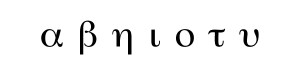
As writing systems are essential to our having a recorded history, letters are as old as time. In his last fable, Hyginus states, “The Parcae – Clotho, Lachesis, and Atropos invented seven Greek letters.”

ΑΒΗΙΟΤΥ

The novel I’ve set in mythological Greece won’t be written in Ancient or Modern Greek but I have been making an effort to get the character names and certain terms correct. Effort at being thorough and accurate has often taken me to the area where fascinating letters become tricky things — in combination they invite pronunciation, spelling, and meaning.

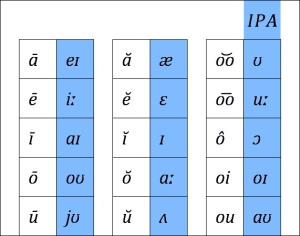
During my formal education the pronunciation key in any dictionary made use of diacritical marks. Later the International Phonetic Alphabet (IPA) became the key of choice. Though there is an online English-to-IPA translator, I’ve yet to find one that works in reverse. I still have to compare IPA vowels to a diacritical chart.

dia v ipa

In addition to the story of Teiresias, another novel in development takes place chiefly in WWII-era Great Britain. This setting brings up an entirely new set of permutations of expression and a few slightly different vowels.

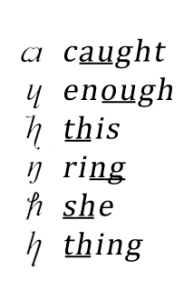
While on his third visit to England and attempting, among other things, to have Pennsylvania made a Royal Colony rather than a proprietary province, Benjamin Franklin devised A Scheme for a new Alphabet and a Reformed Mode of Spelling.

The premise of any phonetic structure – beyond illustrating pronunciation – is that knowing how a word sounds is the same as knowing how to spell it. Dr. Franklin removed c, j, q, w, x, and y. Six new letters were introduced. The rules are not included here but many websites provide them.

Franklin letters

It seems unlikely that Franklin’s scheme could have replaced the alphabet; it would have meant having to relearn to read and write for those who already knew. Dr. Franklin did give permission to another to try.

“As an independent nation, our honor requires us to have a system of our own, in language as well as government. Great Britain, whose children we are, and whose language we speak, should no longer be our standard…” — Noah Webster

Both men became more involved with The American War of Independence. Spelling and use of certain words were deliberately – and apparently irrevocably – changed. The British-import alphabet thankfully remained.

When not writing or involved with other arts and history, I sometimes explore the world of conlanging – a documentary about which was directed by a friend of mine – Britton Watkins. Conlanging is the pursuit of developing new languages and/or alphabets, usually for the sake of fiction.

Examples include languages of Tolkien’s elves and of Roddenberry’s aliens (developers include Dorothy Jones Heydt, Mark R. Gardner, and Marc Okrand). Mr. Watkins has also produced a very thorough and beautiful font for writing in Vulcan. The best-known real world conlang may be Esperanto, created by L. L. Zamenhof and offered with high hopes as “an easy-to-learn, politically neutral language”.

I hesitate to say that most conlangers use the IPA while developing their new languages but many do. This is particularly true of most of the dozen or so who’ve attempted a Circular Gallifreyan font. Exceptions include the systems by Loren Sherman and Rachel Sutherland, respectively. Their alphabets are the most commonly used by fandom.

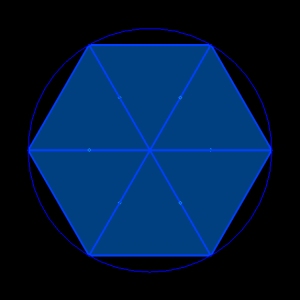
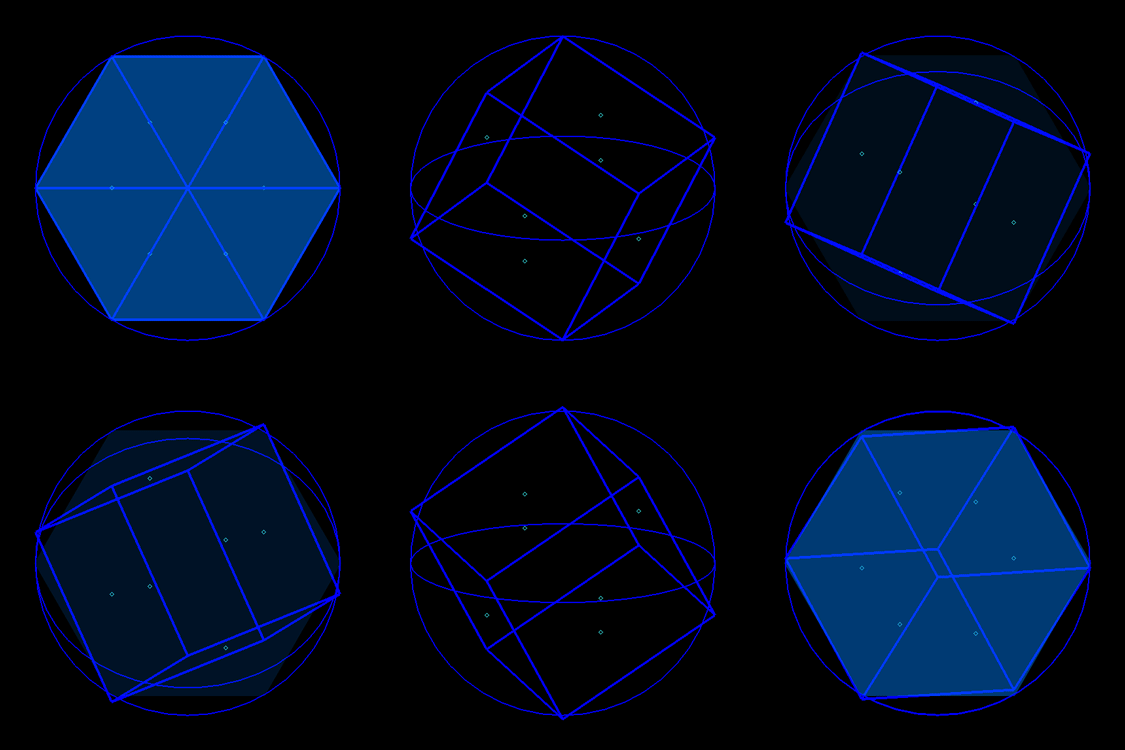
Hexagon

All this to say — we may not have been looking at the symbols of the Time Lords from quite the right vantage point. Every letter – real or imaginary – is two-dimensional. Given time and relative dimensions in space, Gallifreyan letters may not be flat shapes; I don’t think it’s Circular at all. For the sake of art and of curiosity, I am developing a new system and will likely produce a font and/or Photoshop Brush Set. The guide will include IPA and diacritical alike.

revolve


鬼劃符

On the plurality of worldviews…

The presentation of a heptad of must-see sights in all the world is at least 2,500 years old. Only a few of the actual lists survive; some are known only by reference made in other works. There is generally agreement on six of the seven wonders. The Colossus of Rhodes could not have included by Herodotus. The supposedly harbour-spanning statue was not built until 150 years after his death.

All of the sets of Seven Wonders of the World do agree on one other thing. Each suggested stop for itineraries was offered with the pragmatism of actually paying a visit. Islands in the sky (Aeolia) and divine palaces (Mt. Olympus) never made the cut.

If allowing for the inclusion of imaginary places, no one’s list can be expected to match another. My birthday was this week so I’m treating myself to my choice of the seven. Your results may vary.

Dream

  • The Dreaming

Starting in January of 1989 author Neil Gaiman, and a pageant of talented artists beginning with Sam Kieth, gave us a continuing (re)introduction to the realm of Morpheus. The Dreaming contains everything dreamt or that might be. One location within that is of particular note is Lucien’s Library. Like the features of the domain surrounding it, the books shelved here do not exist in the real world. They are yet to be written (presumably including my own works-in-progress); once completed they vanish from the Dreaming.

The original comic series ran for 75 issues. Roughly a year later, Derek Pearcy adapted the French game Magna Veritas. Steve Jackson Games published it under the name In Nomine. One supplement for this game offered dreamlands as the province of the Archangel Blandine.

  • Arda, The Realm, etc.

Even before the film adaptations of J. R. R. Tolkien’s The Hobbit and The Lord of the Rings by Peter Jackson, artists were inspired to explore the legendarium of Middle-earth. The resulting work is just as inspiring, particularly when the subject is any place called home by the Elves. More than just an extended stay – living in Lothlórien or Imladris (better known as Rivendell) would be ideal.

  • The Wizarding World

If Hogwarts existed in reality, I doubt I’d enroll. (I’m probably more of a mutant than a mage.) However, I would certainly appreciate a tour the campus. Moving stairwells. Animated oil paintings. Interactive ghosts. The School of Witchcraft and Wizardry is a fascinating place. If venturing into the wider, though hidden, world of J. K. Rowling it would be fun to window shop Diagon Alley and maybe meet a dragon.

  • The Discworld

Landfall would not be necessary for the most stunning vista here. A few orbits and scads of photos would suffice. Terry Pratchett stated that the inspiration of Great A’Tuin was a summary of a myth he read at about the age of nine. The description of a flat land on the backs of elephants, themselves on the back of a giant turtle, he claimed was part of a book on astronomy.

The turtle in question is doubtless Akūpāra, the Unbounded, from Hindu literature. Similar beliefs appear in the lore of Native American nations, such as the Iroquois and Lenape.

  • The Etherium

When I was asked for a review of Treasure Planet (2002), I said it was the Disney film for which I’d waited my whole life. The novel on which it is based was, of course, an assignment but I enjoyed reading it. Tall ships and astronomy are mostly unrelated, life-long fascinations. How could a combination be bad?

This very concept was explored in Swords of the Swashbucklers (Marvel Comics, Oct. 1984; Epic Comics, Mar. 1985-Mar. 1987) and the Spelljammer campaign setting for Advanced Dungeons & Dragons (TSR, Nov. 1989-Aug. 1993). There is also a scene in The Adventures of Baron Munchausen (1988), in which some of the characters escape from captivity by climbing the crescent moon. All the while, constellations swim like living creatures in the background.

Which brings us to Montressor Spaceport in the Etherium (i.e., outer space). Watching a crescent moon turn from this…

The Moon

to the view below was one of the most exciting elements of the film for me.

Montressor

  • The United Federation of Planets

Within the territory patrolled by Starfleet, one might wish to vacation on the so-called “Shore Leave planet” or on the “pleasure planet” of Risa. It would be interesting to witness two stars merging into one (as in “Ship in a Bottle”) or an actual Dyson sphere (“Relics”).

Alternatively, this could be where I’d snark about J. J. Abrams as a custodian of the Star Trek universe and the destruction of Spock’s homeworld but I’ll simply gesture in that direction – going straight on to planetfall.

t'khasi

Vulcan is a place about which I’ve some strong opinions. If fact-finding could happen on a fictional planet, this would be a dream come true.

Tardis

  • The TARDIS

The Doctor’s description of where the TARDIS can go is a perfect summary.

All of time and space; everywhere and anywhere; every star that ever was. Where do you want to start?

Where?

A tour of the original Seven Wonders of the Ancient World ending with the Hanging Gardens of Babylon gift shop.


On the clock…

The most frequent description of the character arc for a protagonist is called the Monomyth or The Hero’s Journey. This isn’t really an outline for the story. It presents an invitation to a date with destiny and is a road map for the main character. The story is about the destiny itself.

In an article I read recently, the claim was made that all the decision-makers in Hollywood are aware of this formula. That’s probably true but impossible to confirm. The article in question went on to imply that adherence to the monomyth is expected. If so, the audience is reacquainted with the Hero’s Journey with each and every story – even if they’re unaware of the structure. Does this mean members of the audience are indoctrinated to expect the monomyth? Are they evaluating stories based on this – even unconsciously? Is there value in exploring alternatives to this structure (made famous by Joseph Campbell and Christopher Vogler)?

Clock

Imagine the Hero’s Journey as a clock. Let’s say our Hero starts at Noon and ends at Midnight. It’s going to be a long day. She or he begins and ends at a metaphoric home. The first hour of the story shows us the world the Hero lives in, what daily life is like, and what responsibilities he or she has.

1

By 2:00ᴘᴍ, however, comes the introduction of a crucial shift in those responsibilities. The Hero spends the following hour presenting reasons that this change (and the new work it represents) can be done by someone else or avoided entirely. All the while, particularly between 2:00ᴘᴍ and 3:00ᴘᴍ, the Hero learns more about the situation and perhaps just why things were not ideal earlier that morning. All of the lessons during this hour are meant to illustrate not only that the Hero has a date with destiny – said date is an undeniable obligation.

2

People fear change. Our Hero is no exception. Until about 4:00ᴘᴍ, the Hero has been experiencing the stages of grief, in a sense. The day has provided shocking news. The Hero has attempted to deny the news and to bargain a way out of dealing with it. As the duty to respond grows inevitable, our Hero finally gives it serious thought and begins, at least mentally, to prepare to deal with it.

3

Perhaps for the sake of emphasis or as an actual intervention, someone arrives to kick the Hero into the real world. It is 4:00ᴘᴍ. This is the mentor, who may have arrived with a useful tool to present as a gift. From 5:00ᴘᴍ to 8:00ᴘᴍ, everything the Hero experiences is new. This is a total immersion and each skill the Hero learns is applied immediately of necessity. There are failures during this stage, of course. The Hero may even experience doubt and seek to quit.

4

At about dinnertime, some stories introduce a specific woman. She may seek to lead the Hero off the new road. Alternatively she may serve as a second mentor. This means the presentation by point or counter-point of the same theme. Depending on the manner of the character, the same line of dialog can be encouragement to quit or to continue. Note: If such a character is included here the author should be careful not to present this woman as a stereotype and cypher. If this sort of message must be delivered to the Hero and the audience, the messenger doesn’t have to be a woman. There’s a risk – as the monomyth is traditionally presented – of an approach to misogyny here.

5

By 7:00ᴘᴍ the Hero finally knows what’s really going on and what must be done. The date with destiny is set at 8:00ᴘᴍ and the Hero’s determination is now a true commitment. Of course the Hero wins. That is, very probably, why she or he is the Hero of the story. At 9:00ᴘᴍ, there’s a reward for all the trouble and injury along the way.

6

But it isn’t Midnight yet. The defeat of the villain is only partial and the payment for service may be intended as a another distraction. The Hero is unaware of this and it’s been a hard day at work – including overtime. There’s been an unexpected bonus. Ten o’clock. Time to go home. The way home is filled with obstacles. There may even be a race. The victory back at 8:00ᴘᴍ left loose ends. The road home proves the lessons have been learned and the skills are now an intrinsic part of the Hero. The transformation is genuine.

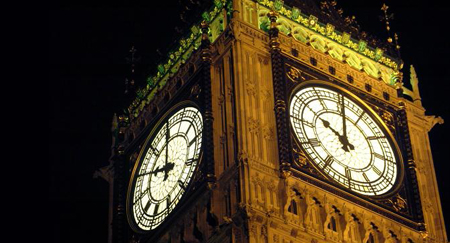
big ben

This final triumph comes at the Eleventh Hour and there’s an epiphany following. The Hero’s reward is reinforced by this event and the last steps home complete the transformation. As the clock strikes Twelve, the check is cashed, and it can finally – actually be time to celebrate.

8

All this to say, the author is not bound to this structure any more than the hero should be considered a slave to the story. If there is no choice, there is no story. If it is true that all good stories following the monomyth it is important to remember that all bad stories do as well. What matters more than compliance, then, is how the tale told departs from the formula. Going off the clock is part of what makes the story worth telling and memorable.


🕛

Well, why not write?

There are four stories pushing at me (not counting those planned with my coauthor). In pondering each over the past week or so, I was a little surprised to realize that each stems from a different purpose in telling.

For longer than I can precisely recall, I have criticized a lot of films with the label “big, dumb, testosteronedriven explosion movie”. I’ve never been particularly interested in writing a romp. That’s not the objective or, I should say, there is an objective.

Each of the stories I have in progress came from quite different moments of inspiration. Some were like unexpected bolts of lightning while others were the result of prolonged brainstorms.

Comprehension of a lifetime’s factors —

One of the novels began as a spreadsheet for sorting data and looking for trends. It wasn’t intended to be a story at all. Trends in the information, however, began to suggest a narrative. The more I looked, the more compelling and fascinating (to me) it became. There actually was a narrative in the chart and it sprang out of it in an almost parthenogenetic way.

Expanding the perception of courage —

The second book was inspired by a single image. I cannot say if the artist had any story in mind but it made me think of a “band of brothers” situation. The main characters in said band all happen to be young women. For a brief moment it seemed that Sucker Punch might be what I had in mind but the reviews given by friends dissuaded me from that notion and from seeing the film.

The diligence of the heart —

Folklore has many tales that predict the return of a hero or of a force. Imagine such a situation were to transform a part of the world – and everyone in it – almost in an instant. What aspect of human nature and emotion could then be examined? What would prove you were still human despite the change and how far would you go to prove it?

Making sense of nonsense —

Science fiction series, when they include sentient aliens, eventually generate a set of stereotypes concerning them. Even Star Trek and Doctor Who have not proven immune. Examining the Vulcans logically reveals that much of what we think we know about them doesn’t make a damn bit of sense. I aim to explain the contradictions.

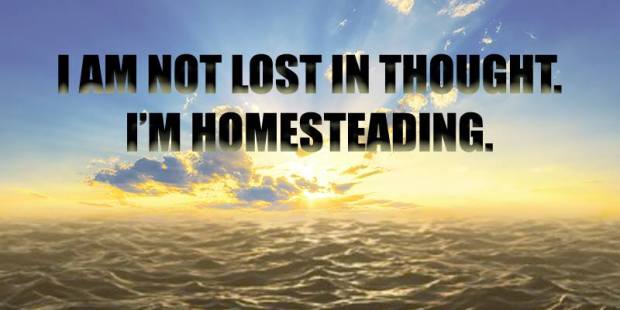
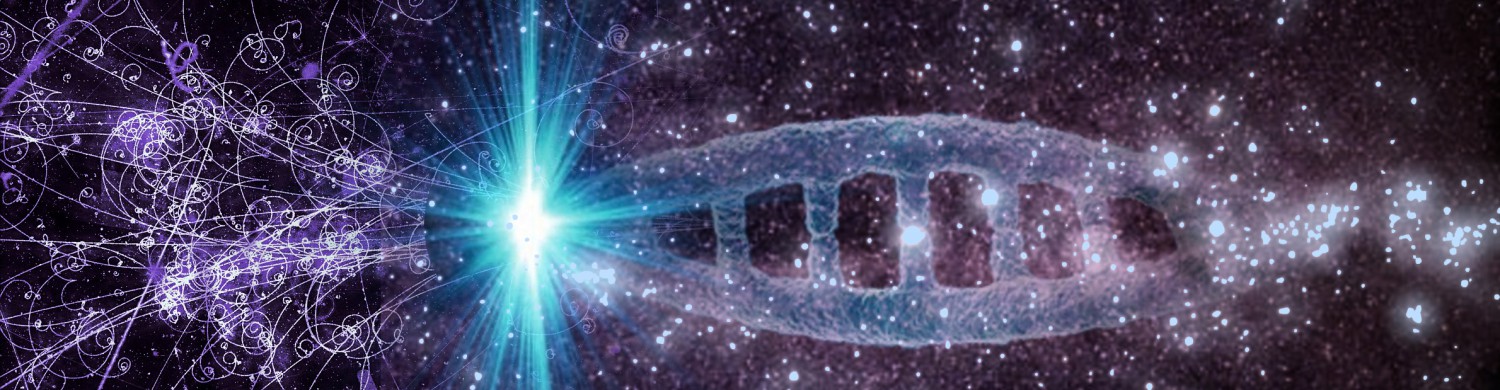
For just a little over a year, I have been posting here on a weekly basis. Somewhat prior to adopting that habit this blog kicked off with a simple image. If my reason for writing can be distilled to a single sentence, it is captured in that banner.

Homesteading


It’s poetry in motion…

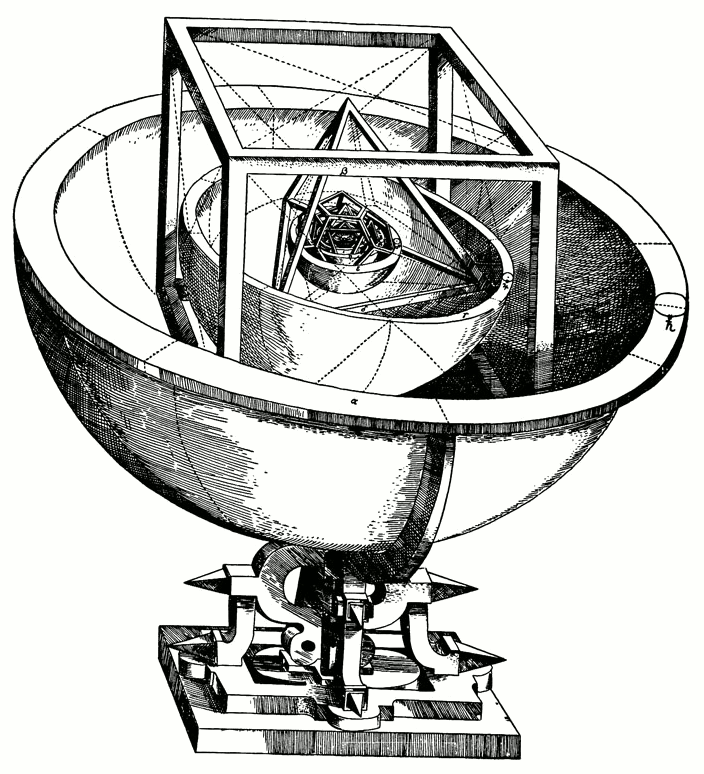
We are – for lack of a better word – programmed to look for meaning. Our education works to enhance this natural tendency. It may be why some have an affinity for sacred geometry. Certainly Johannes Kepler attempted to demonstrate that meaning was a built-in feature the solar system (Mysterium Cosmographicum, 1596).

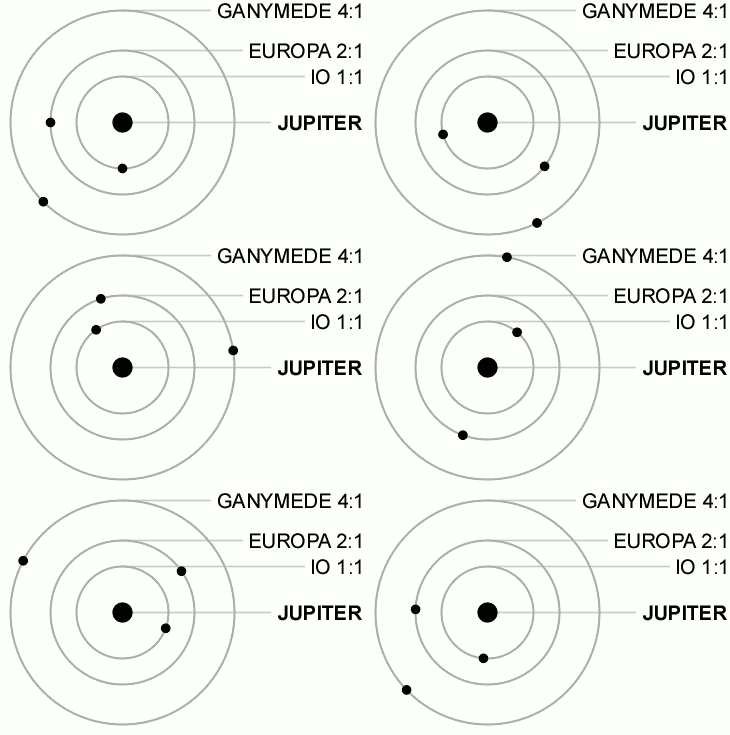
Kepler-solar-system-1The phenomenon of one or two orbits helping to predict the next may not be by design but gravity does create some poems in the cosmos. Resonances – such as that between Jupiter’s moons of Io, Ganymede and Europa – are my favorite example. For each of Io’s orbits, Europa makes two and Ganymede makes four.

Galilean_moon_Laplace_resonance_animation_2But science is not the only field of study.

Imagine there were some mental equivalent of gravity and celestial bodies. Suppose that this explains why certain ideas – presumed forgotten – return to us from time to time. Or that it is precisely why certain locations are thought to be frequented by ghosts. Wouldn’t that be cool?

For quite a long while I have enjoyed this poetry and I can see why it has an appeal, particularly in astrology. It would be very nice to know why the wheels seem to fall off the wagon when Mercury is in retrograde (which it isn’t) or why it’s a good idea to be more mindful when Uranus is in retrograde (and it is). And though these changes are not caused by planetary action, the poetry serves as a reminder that they do, however, happen.

Notwithstanding ☿ and ⛢, et al. – or haunting thoughts or spirits – the cosmos is a very big and usually unpredictable place. Maybe it’s unfair to consider astrology a pseudoscience.

Certain aspects are really just a To Do List.